
Application and Practice of Industrial-Grade Heavy-Duty Workbenches in Factory Workshops and Assembly Operations
In modern manufacturing, maintenance industries, and experimental testing fields, a “workbench” is not just a piece of equipment, but a fundamental carrier supporting on-site operational processes. With increasing requirements for production environments, heavy-duty workbenches featuring load-bearing stability, vibration and noise reduction capabilities, and storage functions have found more widespread applications in factory workshops, assembly lines, and maintenance workstations.
This article focuses on the structural characteristics, installation, and usage scenarios of common industrial-grade heavy-duty workbenches, without involving sales or promotional content, intended solely for understanding and reference by production and technical personnel.
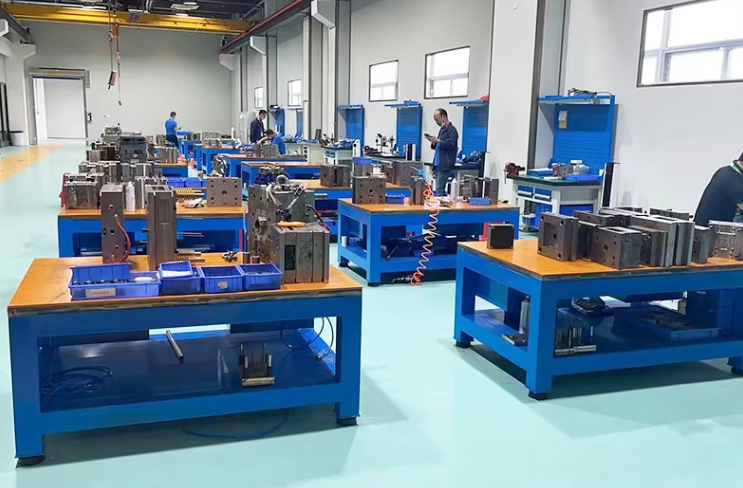
Heavy-Duty Workbench – Chinese Product Description
I. Main Structural Features of Heavy-Duty Workbenches
According to document information, industrial-grade heavy-duty workbenches are typically constructed with cold-rolled steel plate frames and reinforced tabletops, featuring the following structural characteristics:
1. Sturdy and Stable Tabletop with Load-Bearing Capacity
- Tabletops commonly use approximately 16mm thick water-ground steel plates
- Surface is flat and wear-resistant
- Capable of withstanding continuous impacts and heavy object operations
- Suitable for workstations requiring high load-bearing capacity such as assembly, cutting, hammering, and fixture clamping.
2. Vibration and Noise Reduction Design
To reduce on-site noise and vibration transmission, heavy-duty workbenches can be equipped with:
- Vibration-damping rubber pads installed beneath the tabletop
- Shock-absorbing rubber foot pads installed on the legs
- The structure effectively absorbs impact vibrations, improving operational experience and surrounding environmental stability.
3. Adjustable Foot Cups to Adapt to On-Site Ground Conditions
Workshop floors may have slight height differences; through cast iron foot cup adjustments, the following can be ensured:
- Workbench levelness
- Improved operational safety
- More stable equipment placement
- Maintaining bench stability is fundamental for all mechanical and manual operation workstations.
4. Drawer Storage Design
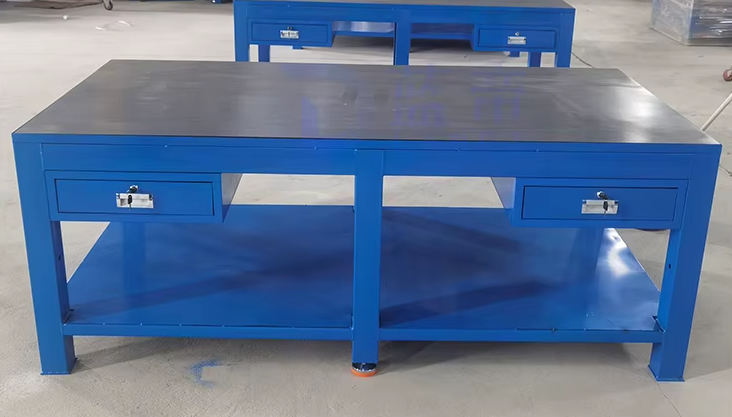
Some factory workshop workbenches are configured with storage drawers, supporting high-load-bearing slides:
- Single drawer can bear approximately 100kg
- Quiet push-pull structure
- Internal space for storing tools, measuring instruments, and components
- This is a common configuration solution for improving efficiency on assembly lines and maintenance workstations.
5. Surface Coating Treatment
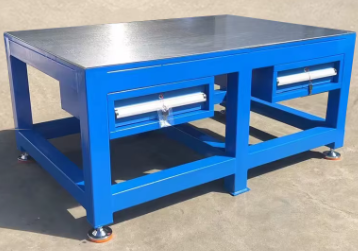
Surface treatment uses phosphate-free electrostatic spraying process, which enhances:
- Corrosion resistance
- Anti-rust performance
- On-site ease of cleaning
- Adaptable to environmental conditions in experimental areas, workshops, and semi-open outdoor areas.
II. Typical Application Scenarios for Industrial-Grade Heavy-Duty Workbenches
Combined with document content, heavy-duty workbenches are commonly used in the following areas:
- Factory Workshops
Used for production operations, maintenance, component processing, trial assembly, and other operations. - Assembly Lines
Station personnel can complete tightening, press-fitting, welding preparation, and other processes through stable tabletops. - Maintenance Workstations
Suitable for maintenance, disassembly, component storage, and equipment debugging. - Technical Experiment Operation Areas
Laboratory spaces requiring stability and precision operating environments.
III. Installation and Debugging Considerations for Heavy-Duty Workbenches
To ensure usage stability and reduce safety risks, on-site installation typically follows these steps:
- Check that all components and accessories are complete and undamaged
- Install foot cups at the bottom of the frame, reserving adjustment travel
- Fix the tabletop to the frame, maintaining structural tightness
- Check drawer slide installation and smooth operation
- Use a level to level the workbench
- Tighten foot cup nuts to ensure the workbench is completely stable
These steps can reduce later issues such as tilting, shaking, and abnormal noises.
IV. Daily Use and Maintenance Recommendations for Workshop Heavy-Duty Workbenches
During long-term use, regular inspection of the following items is recommended:
- Whether foot cup locking nuts are loose
- Whether drawer slides operate smoothly
- Whether screw connections are loose
- Whether vibration-damping pads are worn or detached
- Whether surface coating has scratches or rust marks
Maintaining cleanliness and stability helps improve the service life and safety of workbenches.
Conclusion
In manufacturing factories, assembly production lines, and maintenance work areas, heavy-duty workbenches have become important basic operational equipment. Their stable tabletops, vibration-resistant design, storage structures, and adjustable support feet provide reliable support for on-site operations, capable of adapting to various industrial environments for tool placement, component assembly, and precision operation requirements.
Proper installation and maintenance can further enhance the safety and efficiency of heavy-duty workbenches during long-term use in factory workshops, providing a stable working foundation for production and maintenance.