
Tool Cabinets for Auto Repair and Bike Shops — Drawer Layout, Casters and What Wears First
A two-bay auto shop buys a tool cabinet. Fourteen months later the second drawer starts dragging. The owner blames the cabinet. What actually happened is brake dust in the slide track. The drawer was also loaded past its slide rating.
Tool cabinets in workshops fail in a predictable order. Slides go first, then casters, then locks. The steel body usually outlives all three. That order is the whole design brief: build the shell once, and treat slides, casters and locks as serviceable parts. Everything below follows from it.
What wears first, and why
Drawer slides fail before anything else in a workshop. Two reasons cover most cases. The first is grit — brake dust, grinding dust and swarf settle into the ball track. The second is overload, and it usually stays invisible until the slide starts to bind.
Casters are next. A loaded cabinet is heavier than it looks, and a small wheel rolls over debris rather than clearing it. Cheap casters flat-spot when the cabinet sits loaded for months without moving.
Locks and hinges come after that. The body — cold-rolled steel with a powder-coated finish — rarely fails at all. If a supplier’s warranty conversation starts with the shell, the parts that matter are being avoided.
Dust control is the cheapest maintenance a workshop can do. A blow-out of the slide tracks every few months adds years to a drawer. Where the floor is swept with compressed air, slides fill fastest. That shop needs sealed ball cages, or a cabinet parked out of the airstream.
How many drawers a bay actually needs
Drawer count is a working question, not a spec-sheet question. A single auto technician with hand tools, air tools and diagnostic gear usually lands between seven and ten drawers. Below seven, tools end up sharing space and the sorting system collapses.
Bike shops run a different pattern. Tools are lighter but more numerous, and small parts matter more than bulk. Ten to twelve shallow drawers beat six deep ones. A wide flat drawer for wheel and frame work earns its space.
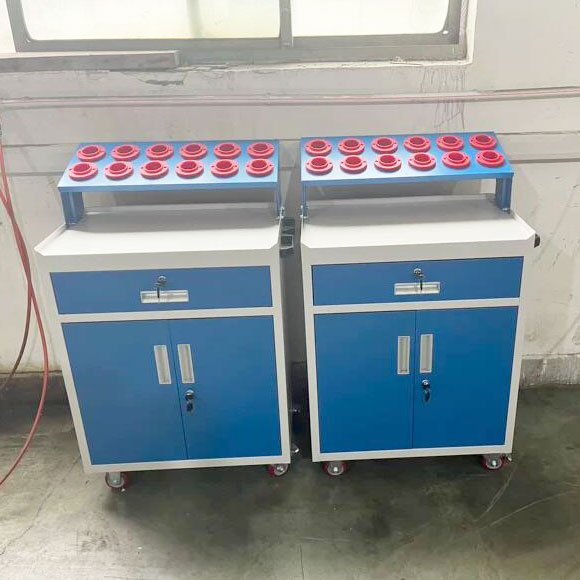
Drawer height by what goes inside
Height allocation decides whether the cabinet stays organised after month three. A common failure is a wall of identical drawers. Long tools then lie diagonally, and the back half of every drawer goes to waste.
Deep drawers belong at the bottom, where sockets, air tools and pullers live. Mid-height drawers take wrenches and screwdriver sets. Shallow drawers at chest height hold small parts, bits and measuring tools. That gradient matches how often each layer is opened.
| Bay type | Drawer count | Layout priority | Caster need |
|---|---|---|---|
| Single auto technician, hand and air tools | 7–10 | Deep base drawers for air tools, shallow top row for sockets | Yes — tools move to the vehicle |
| Bike shop, assembly and fitting | 10–12 | Many shallow drawers, one wide flat drawer for wheels | Yes — bike comes to the bench |
| Mixed auto and bike workshop | 9–12 plus a top hutch | Split the cabinet: deep half for auto, shallow half for bike | Yes, with brakes on all four |
| Fixed diagnostic bay | 6–8 | Fewer drawers, taller cabinet, bench top integrated | Optional — the bay does not move |
Ball-bearing slides versus roller slides
Two slide families cover this market, and the difference shows up in year two. Roller slides run on two nylon rollers in a simple channel. They are cheaper, quieter and fine for light drawers.
Ball-bearing slides run on a steel ball cage. They carry more load, stay smoother under weight, and tolerate a wider drawer. The trade-off is cost and a slightly firmer pull.
Load ratings are quoted per pair, and the number matters more than the type. Slides are commonly graded in three bands. Specify the cabinet by band, not by drawer count alone. A deep bottom drawer loaded with air tools sits at the top of the range.
Full-extension slides are worth the upgrade on the bottom two drawers. A drawer that only pulls out three quarters hides whatever sits at the back. That is where the rarely used tools end up.
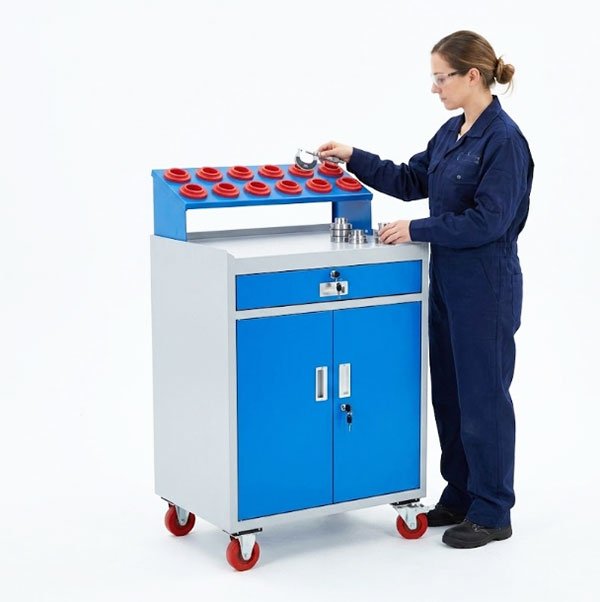
Casters: the spec that decides whether the cabinet moves
Wheel diameter is the first number to check. Small wheels catch on floor joints, cable covers and swarf. Moving up one size solves most of the rolling complaints workshops report.
Wheel material changes the feel. Polyurethane rolls quietly and resists oil. Nylon is harder and rolls easily over rough concrete, but transmits noise. Rubber grips well and stays quiet, and wears faster in a shop with metal chips on the floor.
Brakes are not optional on a loaded cabinet. A cabinet that rolls when someone leans on an open drawer is a tipping risk. Two braked casters on one side is the minimum. Four is better on uneven floors.
Load per drawer, load per cabinet
Two numbers decide the build. The first is what a single drawer carries, with the bottom drawer always the heaviest. The second is the total the casters and frame support when the cabinet is fully loaded.
Most claims fail at the second number. A cabinet rated for a generous total load still fails if one drawer carries double what its slides allow. Ask for both figures, and ask which drawer the rating assumes.
Hengna builds tool cabinets and mobile carts around these two numbers, not around drawer count alone. Drawer layout, slide band and caster spec are set per order. A bike shop and a truck bay need different answers.
- Spec the parts that fail: slides and casters decide service life, not the steel body.
- Load by drawer, not by cabinet: the bottom drawer sets the slide grade.
- Brakes on a loaded cabinet: two braked casters minimum, four on uneven floors.
When a cabinet is the wrong purchase
Four cases where this advice does not apply. If the work is light, a mobile tool cart carries enough. Oil changes, tyre repairs and basic servicing do not need ten drawers. If the bay never moves, casters are dead weight. A fixed bench with drawer units underneath is a better answer.
If tools are shared across bays and walk between them, one cabinet per technician is the wrong model. A tool cart with a lockable top does the job better. If budget is binding, roller slides on shallow drawers are a fair trade. Failures show up on the deep drawers first. Those can be upgraded later.
One more boundary. This covers steel tool cabinets for repair work. It does not cover tool walls, pegboard systems or fixed workstation benches, which follow different logic.
Common questions
What is your MOQ? It depends on the model and the drawer configuration. Mixed containers with carts and cabinets together are normal.
How do you quote? Send the bay type, drawer count, caster preference and destination port. A quote follows within 24 hours.
What about warranty? One year on the cabinet, the slides and the casters. Slide sets and caster sets ship as spares with the order when you ask for them.
Can you do OEM? Yes — silk-screen logo, custom drawer layout and custom manuals. Layout approval happens before production.
How is it packed? Moisture film, corner protectors and separate part packing. Cabinets ship assembled where the container allows, and knock-down where it does not.
The short version
Buy the tool cabinet around its weakest parts. Slides fail first, casters second, and the steel body usually outlives both. Work out the drawer count from the bay type. Then match the slide grade to the heaviest drawer, not the average one. Put brakes on a loaded cabinet, and pick wheel size for the floor it rolls on.
Send the bay type, the tool list and the floor conditions. We will come back with a drawer layout, a slide grade and a quote within 24 hours.
Related guides
- All tool cabinet and cart guides — drawers, locks and load planning for repair bays.
- mobile tool cart guide — casters, slides and the parts that give out first.
- tool cabinet buyer checklist — five things that save you a claim before ordering.
EN 14470-1 Fire Ratings Explained — What the Test Measures and Where Buyers Assume Wrong
Three quotations for the same flammable liquids cabinet land on your desk. All three claim EN...
Read articleStainless Steel vs Powder-Coated Cleaning Cabinets — Which One Survives a Wet Janitor Room
Two quotations sit on the desk for the same janitor cupboard. One is stainless steel, the...
Read articleWarehouse Shelving Load per Shelf — How Buyers Work Out a Safe Capacity Before They Order
A warehouse supervisor stacks cartons four high across a shelf. The rating sticker on the frame...
Read article