
Stainless Steel TCM Herb Cabinet — 48 Drawers for Humid Clinics and Veterinary Practices
For a veterinary herbal practice or a clinic in a humid climate, the herb cabinet is not a storage problem. It is a hygiene and humidity problem with drawers. The 48-drawer format has become the default in that market for one practical reason: 48 drawers with three cells each holds 144 herb varieties, which is the working range of a busy small-animal or mixed practice without taking up a whole wall.
This guide is for importers and clinic buyers specifying that cabinet: what 144 cells holds, why stainless wins in a clinic that washes down, and what to put on the order sheet so it arrives usable.
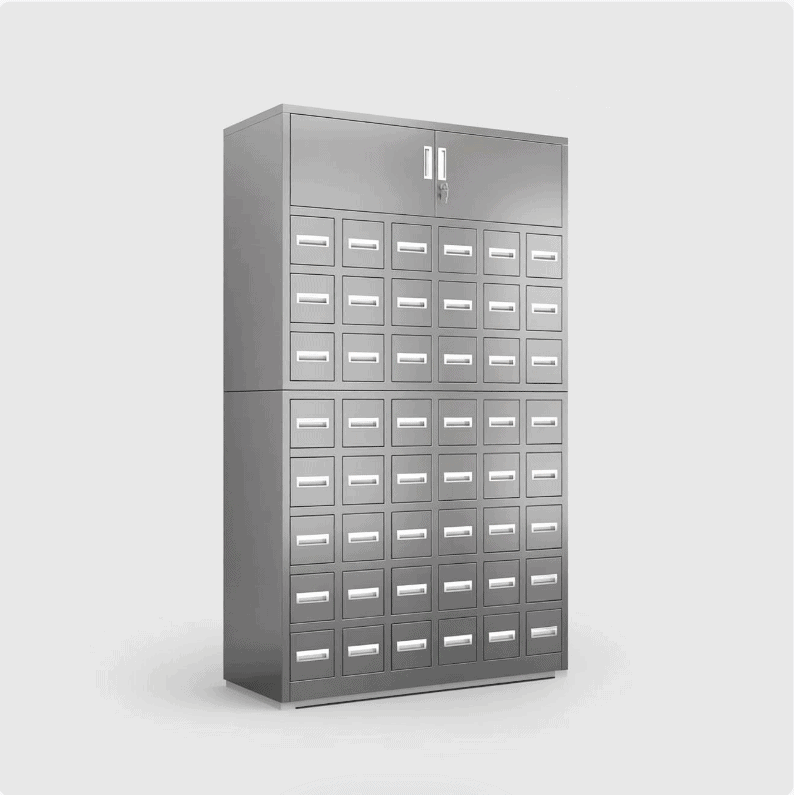
What 48 drawers and 144 cells actually hold
Each drawer is divided by welded separators into three cells, and each cell carries one herb. Three cells per drawer is not a decorative choice: it is what keeps a drawer narrow enough to pull out with one hand while the other hand is on a scoop.
| Drawer count | Herb cells | Who it fits |
|---|---|---|
| 21–36 drawers | 63–108 cells | Solo practitioner, home clinic, veterinary acupuncture room |
| 48 drawers | 144 cells | Small-animal or mixed veterinary practice, community TCM clinic |
| 60 drawers | 180 cells | Multi-practitioner clinic, hospital outpatient herbal pharmacy |
| 70 drawers | 210 cells | Hospital TCM department, regional dispensary |
The 48-drawer body is 1,200 mm wide, 500 mm deep and 1,950 mm high, with a lockable section above the drawers. That width decides your layout: it fits a wall return without blocking the aisle in front of the counter.
Why clinics specify stainless, not painted steel
A veterinary practice wipes, sprays and mops. Painted cold-rolled steel survives that until it does not — and when the coating fails near a drawer edge, moisture gets under the film where nobody can see it.
- Wash-down surfaces. Brushed stainless takes clinic disinfectants without dulling. There is no paint film to chip at the drawer corners.
- Odour and residue. A non-porous surface does not hold the smell of strong aromatics.
- 304 versus 201. Choose 304 where disinfection is constant and the room runs humid; 201 for dry rooms with light cleaning.
For a dry treatment room, powder-coated steel cabinets remain a legitimate choice — the material question is about what the room does to the cabinet, not about status.
Hygiene details that decide a clinic cabinet
Two cabinets of the same size are not equal on cleaning. Three details matter when the cabinet has to be wiped between patients:
- Welded dividers, not clipped-in ones. A welded three-cell divider leaves no channel for powder to collect. Clipped dividers come out with the drawer and leave gaps.
- Flush drawer fronts. A proud front catches cloth and spray; a flush front wipes in one pass.
- Hook stops on every drawer. A drawer that pulls fully out onto the floor is a spill of expensive material and a cleaning job on the floor.
Humidity is the quiet cost
Herbs are hygroscopic: they take on moisture from the air, and moisture means weight that does not pay, dulled aroma and, eventually, mould. In a humid or monsoon-affected climate, three habits protect the stock.
- Keep the cabinet off the floor. Raised feet lift the bottom edge clear of the dampest 100 mm in the room, and they are also what lets a mop pass underneath.
- Keep it away from the sink and the boiler. The strongest humidity gradient in a clinic is the metre around a water source.
- Use desiccant inside the drawers that hold the slowest-moving herbs, and check it on a schedule. The slow sellers are the ones that sit through a wet season.
If your market’s clinics run air conditioning all year, this matters less. If they run open windows and a monsoon, it matters more than the drawer count.
Organising 144 cells for a working practice
An empty 48-drawer cabinet is easy to fill badly. The layout that keeps dispensing fast follows the way the practice actually writes formulas.
- Frequency first. The twenty or thirty herbs that appear in most formulas go at chest height, between 900 and 1,400 mm.
- One herb, one cell, always. Sub-dividing a cell by hand is how mis-dispensing starts.
- Species separation. If one cabinet serves small animals and equine prescriptions, give the large-animal herbs their own row.
- Label holders on every drawer. Printed labels replace handwritten tape, and they survive being wiped.
What to put on the order sheet
| Item | What to specify |
|---|---|
| Drawer count and cells | 48 drawers × 3 cells = 144 varieties, or the count that matches the formulary |
| Material | 304 stainless for humid, heavy-cleaning rooms; 201 for dry rooms; powder-coated steel for dry, light use |
| Dimensions | 1,200 × 500 × 1,950 mm on the 48-drawer body |
| Base | Raised feet as standard; castors if the clinic moves the cabinet for cleaning |
| Locks | Steel core lock with a low cross-key rate; confirm whether the top section is separately keyed |
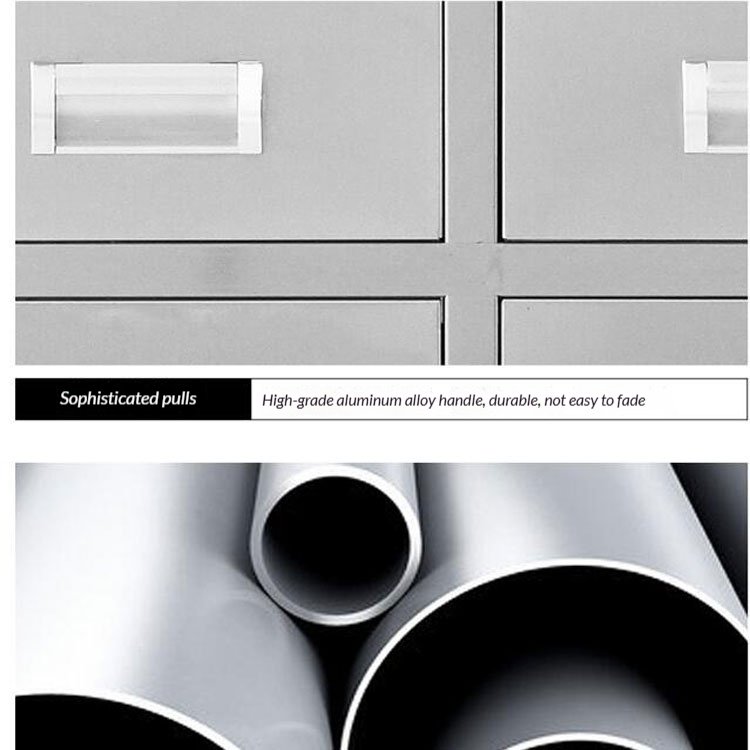
| Drawer hardware | Brushed aluminium pulls, welded dividers, hook stops, label holder per drawer |
| Delivery | Fully assembled, with desiccant packed inside the wrap for the sea transit |
Ask about the doorway before you confirm. A 1,950 mm cabinet arrives assembled, and a 1,900 mm clinic door is a problem nobody wants to discover on the unloading day.
How these cabinets are built and checked
The cabinet bodies come off the same steel line in Luoyang that produces the rest of our medical and workshop range. Drawer fronts are formed as one piece with the pull recess, the dividers are welded in place before finishing, and every drawer is pulled in and out on the stops before packing.
Two records pass on with the order: the stainless grade that batch was built to and the drawer count per body — what makes a reorder six months later match the first shipment.
Custom work is routine: drawer counts from 21 to 70, wider bodies, separate keying for the top section, labels printed to a clinic’s herb list. Send the formulary size, the room humidity and the doorway dimensions, and we will return the configuration and the packing plan.
Common questions
Is 304 stainless really necessary? In a room that is disinfected daily and runs humid, yes. In a dry treatment room with light cleaning, 201 or powder-coated steel performs fine.
Can the cabinet be washed down, not just wiped? Wipe-down, not hose-down. Stainless handles clinic disinfectants; it is not a wet-room fixture, and standing water on the floor is the bigger risk to the herbs.
Do the drawers come out for cleaning? Yes, they lift out on the hook stops, which makes cleaning the drawer and the runner a two-minute job.
How many herbs does a veterinary practice stock? Many small-animal practices run 80 to 130 varieties — the 48-drawer body fits at 144 cells with room to grow.
What does the warranty cover? One year on the cabinet from delivery, with terms for bulk orders confirmed on the order along with the packing method.
The short version
For humid clinics and veterinary practices the decision is cells, wash-down and labelling: 48 drawers at three cells gives 144 varieties in a 1,200 mm footprint, stainless takes the daily disinfectant, raised feet and desiccant manage humidity, and welded dividers with label holders keep it cleanable between patients. Check the doorway, and order it assembled.
Send the formulary size, the room conditions and the doorway dimensions, and we will come back with the configuration, the material grade and a quote within 24 hours.
TCM Dispensing Station Layout: How to Arrange Cabinet and Counter for Faster Prescriptions
Counter length, cabinet reach, and walking distance: how to arrange a TCM dispensing station so the pharmacist never steps away from the herbs.
Read articleSteel vs Wood TCM Medicine Cabinets: Which One Belongs in a Modern Pharmacy?
Humidity, pests, drawer slides, cleaning, and fire: what wood hides and what a steel TCM medicine cabinet delivers over ten years of pharmacy service.
Read articleTCM Medicine Cabinet Guide: How Many Drawers Does a Pharmacy Actually Need?
Count the herbs on the stock list, multiply by 1.3, and order that many drawers: how to size a TCM medicine cabinet for a…
Read article