
Boltless Steel Shelving Guide — Beam Pitch, Deck Type and How Load Ratings Actually Add Up
Boltless shelving is held together with keyhole slots and snap-in beams. There is no bolt, no screw and no welding in the connection between the beam and the upright: the beam ends drop into punched holes and lock when the shelf is loaded. For an importer, that single detail decides three things — how fast a store room goes up, how the goods travel, and what the spare parts list looks like.
This guide is for trade buyers ordering shelving by the container: what a load rating really means, which deck to pick, and how to count frames and bays so the invoice matches the plan.
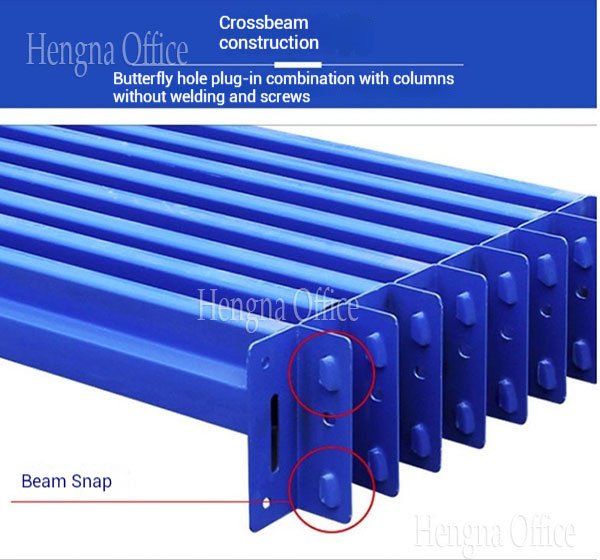
What “boltless” actually changes
A bolted rack takes two people and a spanner to build, and the bolts come loose on a floor that vibrates. The boltless connection replaces all of it with a punched upright and a shaped beam end.
- Assembly with no tools. A two-metre unit goes up in minutes — useful for a leased storeroom, or an end user who will not read a manual.
- Flat-packed for export. Uprights, beams and decks nest into a compact bundle, so more shelving fits in the container.
- Reconfigurable on site. Levels move without drilling, so a store room is re-set when the stock changes instead of replaced.
The three numbers that decide the order
Buyers usually ask for “heavy duty shelving” and stop there. Three specifications decide whether the unit is right, and all three belong on the order sheet.
| Specification | What it decides | What to check |
|---|---|---|
| Load rating per level | The weight one shelf can hold | Rated evenly distributed or as a point load — the two numbers are not interchangeable |
| Level pitch | How finely the shelf heights adjust | Must clear the tallest item stored on top of the deck |
| Deck type | What the load sits on, and how the shelf behaves under impact | Steel panel, wire mesh or board — each has its own rating, separate from the beam rating |
The third one catches people out. A bay rated for 500 kilograms per level with a steel deck panel becomes a different unit the moment a thin board deck is substituted on site. The deck rating is the lower number, and the deck is the number load inspectors read.
How load ratings add up
Our export shelving line runs in three load tiers — 300, 400 and 500 kilograms per level — on a 2,000 mm frame with four levels as standard. Three tiers with four levels is where the arithmetic gets misread.
- Per level is not per bay. A 500 kilogram rating means one shelf, evenly loaded. Four levels of 500 is 2,000 kilograms on the frame — the figure the uprights carry, and not a capacity you can quote per bay without checking it.
- Point loads behave differently. A single 200 kilogram motor sitting in the middle of a shelf stresses the beam far more than 200 kilograms of boxed stock spread across it. When the load is concentrated, ask for the rating at the load point.
- Height changes the rating. The same upright carries less with the beams at the top than at the bottom, so a plan to add levels later belongs in the original order.
Deck options, and what each one is for
| Deck | Typical use | What to check |
|---|---|---|
| Steel panel deck | Heavy boxed stock, drums, parts in bins | Rated separately from the beam; reinforced panels add capacity underneath |
| Wire mesh deck | Cartons, ventilated stock, sprinkler coverage | Point-load performance is weaker than a steel panel of the same thickness |
| Board deck | Light retail back-of-house storage | The cheapest option and the first thing to sag — keep it off the heavy-duty bays |
Frames and bays: how to count what you actually need
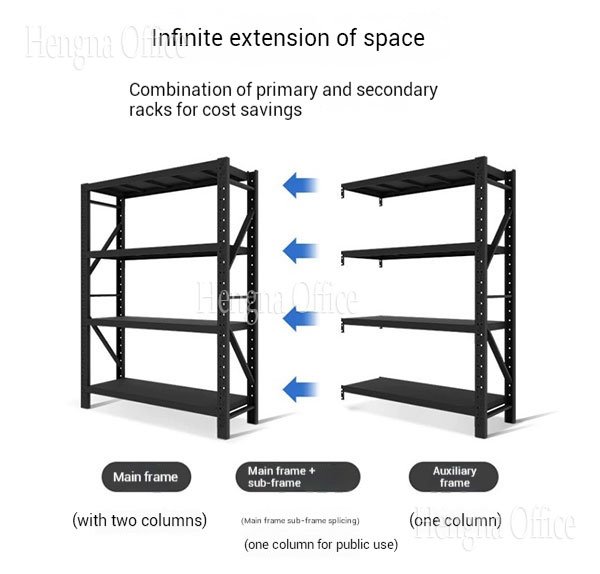
A run is built from main frames (two columns) and sub-frames (one column). A sub-frame shares its neighbour’s columns, so each extra sub-frame adds a bay without buying another pair.
- One bay = one main frame.
- Two bays = one main frame plus one sub-frame.
- Three bays = one main frame plus two sub-frames.
Quoting bays instead of frames is the most common ordering error we see: the buyer assumes each bay comes with its own uprights, and the container arrives with fewer columns than the layout needs. Count frames, then add 10% of spare clips.
Specifications to confirm before the container is booked
| Item | Range on our export line |
|---|---|
| Frame height | 2,000 mm |
| Width | 400 / 500 / 600 mm |
| Depth | 1,000 to 2,000 mm |
| Levels | 4 standard; 3 or 5 on request |
| Material | Powder-coated steel, or 201 / 304 stainless for wet or wash-down areas |
| Structure | Snap-in butterfly clip connection, no screws |
| Certification | CE |
What to put on the order sheet
- Weight per level, and whether the load is evenly distributed or concentrated
- Frame height, width and depth, measured against the room, not chosen from a page
- Level count now, and the level count the site plans to add later
- Deck type per bay, because mixed decks in one run cause confusion at installation
- Frame and bay count, written as main frames plus sub-frames
- Spare clips, levelling feet and labels
- Colour, and packing and carton marking for the destination market
How these units are built and checked
The shelving runs on the same steel line in Luoyang as the rest of our storage range. Uprights are roll-formed and punched, the locking end is formed into the beam profile, and deck panels are pressed with reinforcement underneath — so the rating on the spec sheet is the rating on the floor.
Two records we keep per batch and pass on with the order: the upright gauge and the level rating that batch was built to. That is what makes a reorder six months later match the first container, which matters when the buyer keeps the same product code in stock.
Custom work is routine: colour to match a fit-out, height cut to a ceiling, five-level frames, mixed deck runs. Send the room dimensions, the load profile and the bay count, and we will return the frame count and the spare list.
Common questions
Can boltless shelving be dismantled and moved? Yes — that is the point of the connection. A unit comes apart with the same no-tool motion it went together with, and the panels pack flat for the next site.
How much does one level hold? Three tiers on our export line: 300, 400 and 500 kilograms per level, evenly distributed. For a concentrated load, ask for the point-load figure instead.
Is a wire mesh deck weaker than steel? For point loads, yes. Spread cartons are fine; heavy machinery feet are not.
Can I mix these with a rack I already own? Only if the upright pitch and hole profile match. Send the hole spacing and we will confirm.
What does the warranty cover? One year on the shelving from delivery, with terms for bulk orders confirmed on the order along with the packing method.
The short version
Boltless means the load locks the connection — no tools, flat packing, re-set on site. Order by weight per level with the load pattern stated, deck type named per bay, and frames counted as main plus sub-frames rather than bays. Add spare clips and levelling feet to the same container.
Send the room dimensions, the load on each level and the bay count, and we will come back with the frame count, the deck layout and a quote within 24 hours.
Mobile Tool Cart Guide — Casters, Ball-Bearing Slides and the Parts That Give Out First
A tool cart and a tool cabinet do not fail in the same order. Put a...
Read articleFlammable Storage Cabinet Venting — When Ducting Is Required and When to Leave Bungs In
Most flammable storage cabinets should stay sealed. NFPA 30 does not require venting for fire protection,...
Read articlePhone Charging Locker Specs — Bay Count, Power Draw and Lock Type Buyers Must Pin Down First
Three specs decide whether a container of phone charging lockers sells through or comes back as...
Read article