
TCM Medicine Cabinet Guide: How Many Drawers Does a Pharmacy Actually Need?
TCM Medicine Cabinet Guide: How Many Drawers Does a Pharmacy Actually Need?
Every pharmacy buyer eventually asks the same question: how many drawers does the medicine cabinet need? The answer is never a number. It is a formula, and once you see it, choosing a TCM cabinet takes ten minutes.
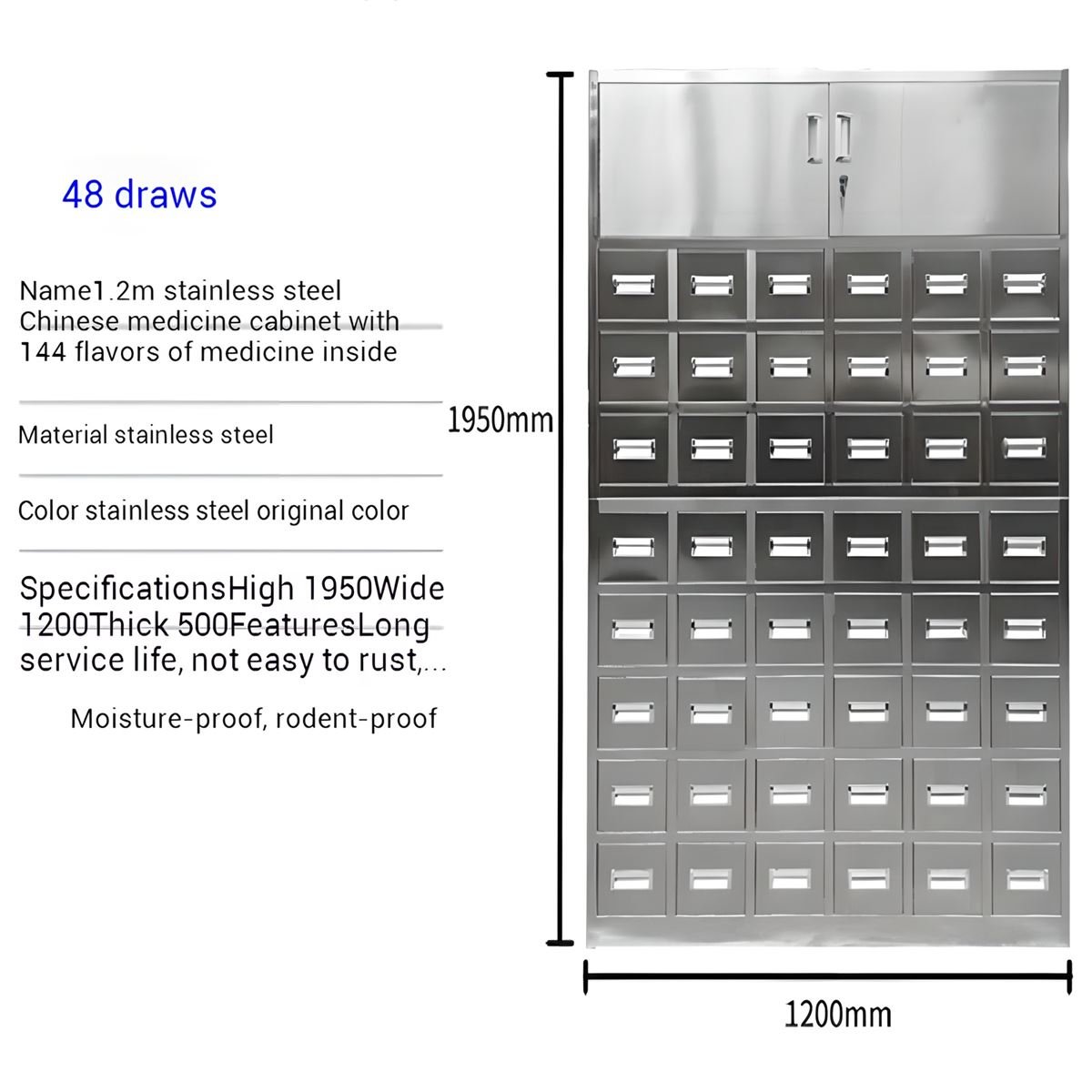
Drawers are not storage. They are labels.
In a traditional Chinese medicine pharmacy, each drawer holds one herb, and the drawer front carries its name. The drawer count is not about capacity, it is about how many different herbs the pharmacy dispenses without stacking or mixing. Mixing two herbs in one drawer is how wrong prescriptions happen.
So the first number to collect is not shelf space. It is the number of herbs on the pharmacy stock list. A small clinic dispensing 80 herbs needs 80 labeled drawers, not a 100-drawer cabinet with empty fronts and not a 60-drawer cabinet with herbs doubled up in drawers.
The standard drawer counts
| Cabinet | Drawers | Herb positions | Typical buyer |
|---|---|---|---|
| Compact bench cabinet | 35 | 105 (3 cells per drawer) | Small clinic, single doctor |
| Standard tall cabinet | 48 | 144 | Pharmacy, TCM department |
| Large pharmacy unit | 60 to 100 | 180 to 300 | Hospital pharmacy, wholesaler |
One drawer commonly divides into two or three cells, so a 48-drawer cabinet can hold 96 to 144 herbs when small-volume herbs share a drawer with labeled separators. High-turnover herbs get a full drawer each. Ask your supplier how the drawer interiors divide, because that changes the real capacity more than the drawer count does.
Size the cabinet to the stock list, plus 30 percent
Write the stock list first. Count every herb the pharmacy dispenses today. Multiply by 1.3 for the herbs that will be added over the next two years, and that is the drawer number to order. The 30 percent is not padding, it is the difference between ordering a cabinet once and ordering it twice.
We build 35, 48, and 60-drawer cabinets as standard, and larger counts to order. Custom drawer counts are routine work: if a pharmacy stock list runs 72 herbs, a 72-drawer cabinet leaves the factory the same way a 48 does, just with more rows.
Drawer depth decides whether herbs dry or spoil
A drawer that is too deep buries herbs at the back, and the back is where damp herbs spoil unseen. Standard drawer depth around 40 cm works for daily dispensing. Ask about the internal depth, not the cabinet depth: a 50 cm cabinet can hide a 35 cm drawer, and that 15 cm difference matters more than it looks.
Ventilation and seals come next. Herbs stay dry in drawers that fit square and close against dust and humidity. A drawer that rattles lets air and pests in. In stainless cabinets, the fit is the quality signal: run your hand along the closed drawer edges, gaps should be even and tight.
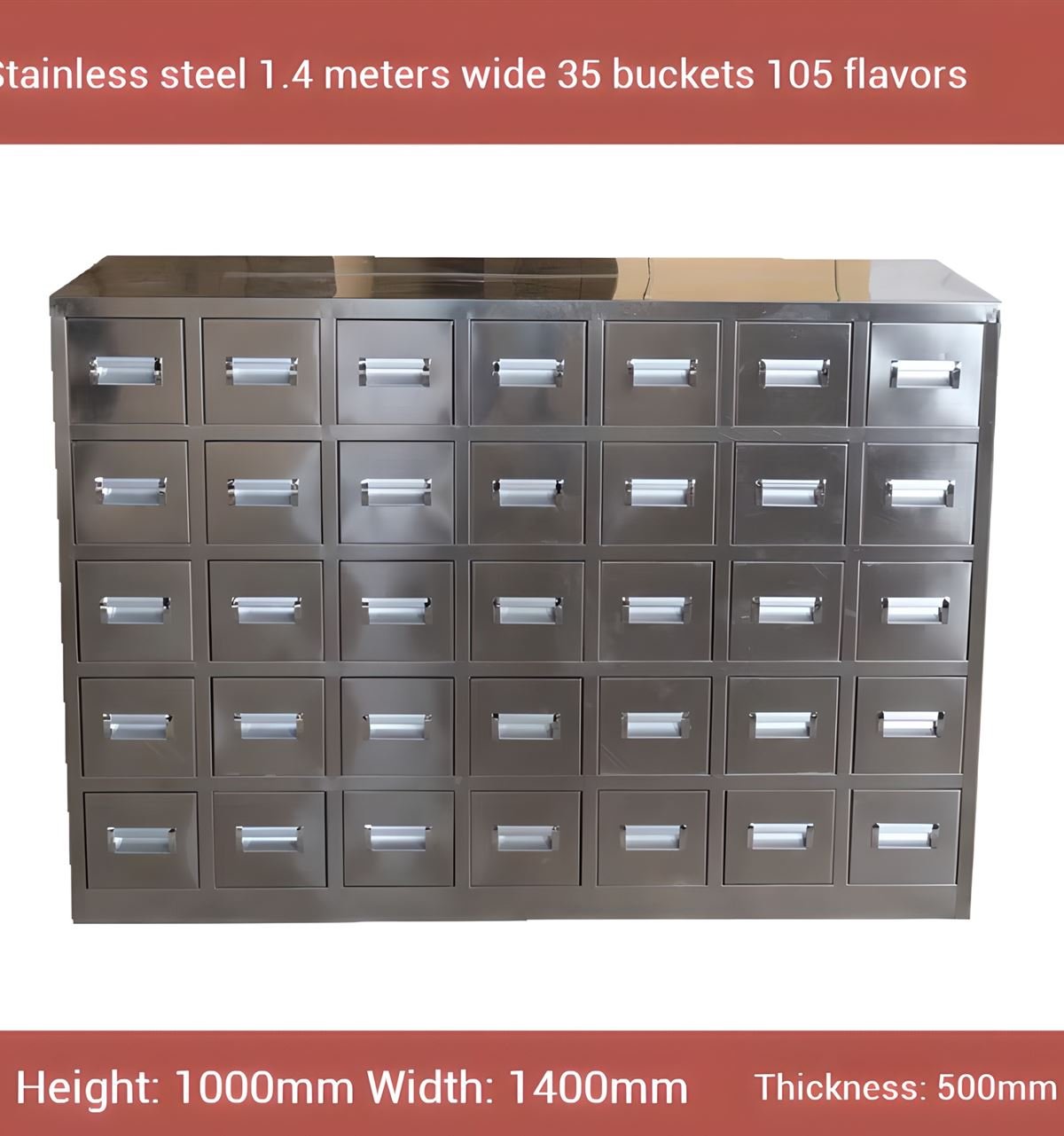
Wood or stainless: what we tell buyers
Wooden TCM cabinets are the tradition, and they look right in a classical pharmacy. Stainless cabinets are the practical choice: no warping in humid climates, no pest entry, no varnish to maintain, and surfaces that clean down between shifts. The countertop area of a stainless cabinet takes daily scraping from scales and mortar work without showing it.
For export, stainless is the standard order. It passes hygiene checks in pharmacies where wood gets questioned, and it ships flat in a container without damage. Wood ships whole and arrives with its own maintenance story.
Where the cabinet sits in the pharmacy
Placement changes how many drawers you can actually use in a shift. The dispensing cabinet belongs behind the counter, within arm reach of the scale and the chopping area. If the pharmacist walks to the cabinet for every prescription, a long pharmacy counter doubles the walking and slows every customer.
Keep the cabinet away from the window. Direct sunlight heats the top drawers and fades the labels. Keep it away from the entrance too: street humidity comes in with every open door, and the drawers nearest the door get the worst of it.
Leave working space on the countertop, not on the drawers. Scales, mortar, paper, and the daily stock sheet all live on the counter. A cabinet with the counter built in as one piece gives you that space without buying a second table.
How we build ours
Our TCM cabinets come off the same line as the rest of our steel furniture in Luoyang. Drawer fronts are labeled to order: herb names, numbers, or pinyin plus Chinese characters, printed or silk-screened. The countertop is one piece of steel, welded and ground smooth, with a raised edge so spilled powder stays on the table instead of sliding off.
Each drawer gets its own cell dividers if you want them, and the runners are set so a full drawer of dried herbs still opens with two fingers. We test every drawer on the line before packing, and we ship with drawers locked in place so a container ride does not knock them out of square.
Common questions
How many herbs fit in one drawer? One herb per drawer as a rule. With two-cell or three-cell dividers, one drawer holds two or three small-volume herbs, each in its own labeled cell. Full drawers go to high-turnover herbs.
Can you print our herb names on the drawers? Yes. Standard is printed labels, and we also do silk-screen or engraved fronts for pharmacies that want the traditional look. Send the herb list and we lay out the drawer plan before production.
Do you make the countertop and cabinet as one piece? Yes. The dispensing counter with the cabinet built in is our most ordered pharmacy setup. It saves floor space and keeps the scale, chopping tools, and drawers in one working line.
What is the lead time for a custom drawer count? Standard cabinets ship within the normal production window. Custom drawer counts add a few days for the layout drawing and drawer front labeling. We confirm the drawer plan with a drawing before cutting steel.
Can the cabinet work without air conditioning? Yes. Stainless cabinets handle humid climates better than wood, but keep the pharmacy ventilated and store herbs away from direct sunlight either way.
What is the difference between a dispensing counter cabinet and a storage cabinet? The dispensing cabinet is the working unit: labeled drawers, countertop, and the pharmacist stands at it all day. The storage cabinet holds bulk stock, often with larger bins instead of small drawers. A busy pharmacy usually runs one of each.
How do I maintain a stainless TCM cabinet? Wipe the drawer fronts and countertop with a dry cloth daily, and wash the counter weekly with mild detergent. Avoid leaving spilled herb powder in the drawer gaps: it draws moisture over time. The cabinet itself needs no repainting or resealing, which is the main reason pharmacies switch from wood.
The short version
Count the herbs on the stock list, multiply by 1.3, and order that many drawers. Check the internal drawer depth and the door fit, and choose stainless if the pharmacy is humid, inspected, or shipping overseas. Send us your stock list and we will return a drawer plan with the quote.
Pathology Wax Block Cabinet: Product Description and Specifications
Drawer dimensions, ventilation, and the details laboratories ask about before ordering pathology cabinets.
How to Choose High-Density Employee Lockers: Steel 12-Door Knockdown Guide
Door count, ventilation, and frame gauge: what matters when you outfit a hundred-person locker site.
How to Choose Steel Filing Cabinets and Wardrobe Lockers for Offices, Schools, and Factories
Drawers for paper, vents for coats: choosing steel storage for offices, schools, and factories.