
Flammable Storage Cabinet Venting — When Ducting Is Required and When to Leave Bungs In
Most flammable storage cabinets should stay sealed. NFPA 30 does not require venting for fire protection, and an unvented cabinet holds vapours better than a badly vented one. Venting is required when the risk inside the cabinet is not fire but poison, pressure or asphyxiation.
That distinction is where installations go wrong. A maintenance team reads the word “vent” on the cabinet, removes both bungs, connects a hose to one port and creates a bellows that pulls room air and ignition sources straight into the cabinet. The cabinet then fails the fire test it was built to pass.
This guide covers the three questions buyers and facility teams ask us: is venting required, when is it actually necessary, and how does a correct installation look.
Start with the bungs, not the ducting
Every flammable cabinet in our range ships with two vent ports and metal bungs, one on each side near the top and bottom. Those ports exist so a cabinet can be vented if the site needs it. Underground, they are meant to stay sealed.
- If you do not vent: both bungs stay in. NFPA 30 requires the openings to be sealed with the bungs supplied by the manufacturer.
- If you do vent: both ports are used, one as exhaust and one as fresh-air inlet, and the installation has to follow the code route described below.
What you should not do is remove one bung and leave the other open. That turns the cabinet into a pair of bellows: every door movement pushes vapour out of one port and pulls room air in through the other. Inspectors write that one up because it defeats the fire rating.
When venting is actually required
Venting stops being optional when the hazard inside moves from flammable to toxic, pressurised or oxygen-displacing. The situations below are the ones that come up in practice.
| Situation | Vent required? | Why |
|---|---|---|
| Flammable liquids only | No | A sealed cabinet keeps fire out for the rated period; venting can weaken that protection |
| Toxic or poisonous chemicals | Yes | Vapour build-up inside the cabinet is the hazard, not ignition |
| Peroxide-forming or decomposing materials | Yes | Gas generation raises internal pressure |
| Compressed gas cylinders | Yes | Leak dilution and asphyxiation control |
| High-vapour-pressure solvents, continuous dispensing | Often | Vapour concentration builds faster than the cabinet can hold safely |
| Local fire authority requires it | Yes | Some jurisdictions require venting regardless of contents |
Mixed storage takes the strictest rule. If a cabinet holds flammables and toxics on the same shelf, the toxic hazard governs the installation.
How a correct vent installation is built
There is one accepted route, and the details are not negotiable because they come from the fire code rather than from preference.
- Remove both bungs and fit flame-arrestor screens. The screens normally ship with the cabinet. The bottom port becomes the exhaust, the top port becomes the fresh-air inlet.
- Duct with rigid metal pipe, rated at least as fire-resistant as the cabinet itself. Plastic hose or PVC pipe cannot take the heat of a fire and is not acceptable.
- Exhaust to a safe location outdoors, or to a treatment device for volatile organic compounds. Venting into the room, into a wall cavity or into a shared duct for clean air defeats the purpose.
- Use a fan rated for the hazard. Non-sparking blades and housing. A standard office extractor is not the right component for solvent vapour.
- Keep the duct run short — 25 feet or less is the usual guidance — and do not manifold several cabinets into one duct.
- Ground the cabinet before any dispensing starts. Bonding and grounding during pouring is a separate requirement from venting, and inspectors ask for both.
Two of those steps cost money to fix later and nothing to plan now: the duct route and the cabinet position. Both should be decided on the layout drawing, before the cabinet arrives on site.
The mistakes that get written up
Across the installations we have seen, the same five problems come back.
- One port only. The worst of them. It turns the cabinet into an air pump for the room.
- Flexible hose. Cheaper, quick to run, and the wrong material inside a fire zone.
- Long, bending duct runs. Pressure drop means the air change rate inside the cabinet is far below what was specified.
- Natural draft. Codes expect mechanical exhaust, not a pipe leaning out of a window.
- Positioning the cabinet under stairs, in a dead-end corridor, or against an electrical panel. Clearance and egress rules apply before any venting question does.
What our cabinets ship with
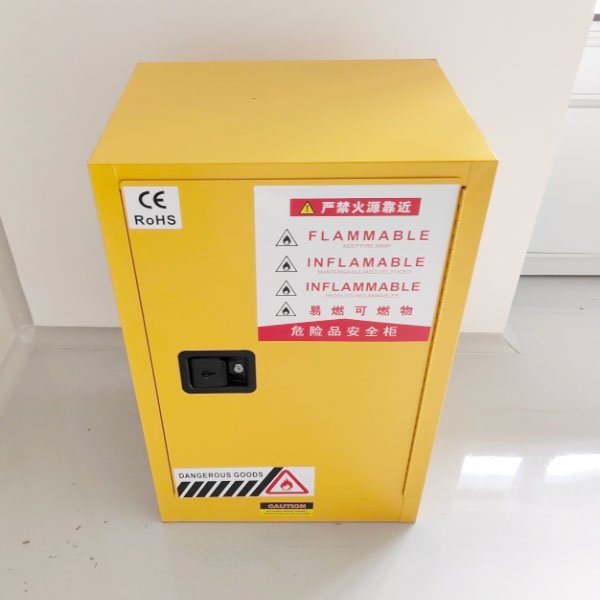
These cabinets are built from heavy-gauge cold-rolled steel with a double-wall body, an air gap between the skins and lined doors. Every unit leaves with flame-arrestor vents and bungs fitted, a grounding connector, a spill tray across the bottom, and a three-point locking system on the doors.
The range runs from 12 to 90 gallons, with 30 and 45 gallon models accounting for most export orders. Shelf positions adjust vertically, and we quote the rated load per shelf so a buyer can check it against the container weights on site.
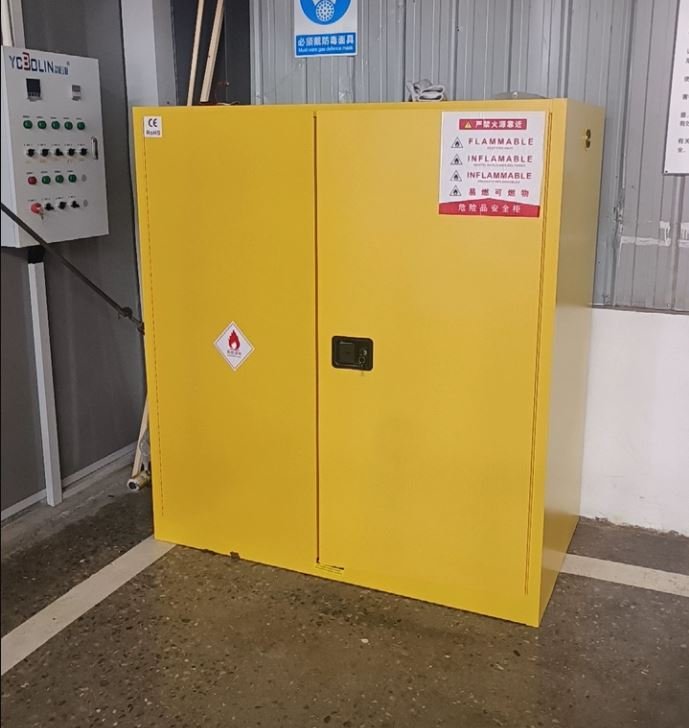
Two ways we help with the venting question at the order stage. First, we confirm whether the destination authority requires venting, because that decision changes the port fittings and the labels. Second, we supply the flame-arrestor screens with the cabinet so the site is not hunting for a small part after the ducts are already on the wall.
Common questions
Do I have to vent the cabinet at all? For flammables alone, no. Keep both bungs in place. Vent when the contents are toxic, will decompose or are pressurised, or when the local fire authority requires it.
Can I vent it into the room? No. Vent outlets go outdoors or to a VOC treatment device, and the exhaust must not discharge near an air intake.
What is a bung? The threaded metal plug that seals each vent port. Cabinets ship with them fitted, and the code expects them back in place on any cabinet that is not being vented.
Do the flame-arrestor screens come with the cabinet? Yes. They fit the same openings as the bungs, and they are what stops a flame from travelling back down the duct into the cabinet.
Can the same cabinet be vented later? Yes, provided the site plans the duct route. That is why the route is worth marking on the layout drawing even when the cabinet ships sealed.
What does the warranty cover? One year on the cabinet from delivery. Terms for bulk orders are confirmed on the order along with the packing method.
The short version
Leave the bungs in for flammable liquids — that is the code position and it protects the fire rating. Vent the cabinet when toxics, decomposing materials or gas cylinders are involved, and then do it properly: rigid metal duct, both ports used, flame arrestors fitted, non-sparking fan, short run, exhaust outdoors. Plan the duct route and the cabinet position on the layout drawing, not on the day the cabinet arrives.
Send us the chemicals you are storing and where the cabinet will sit, and we will come back with the size, the venting guidance for your market and a quote within 24 hours.
Phone Charging Locker Specs — Bay Count, Power Draw and Lock Type Buyers Must Pin Down First
Three specs decide whether a container of phone charging lockers sells through or comes back as...
Read articleSteel Filing Cabinet Mistakes: 5 Specs That Ruin Office Storage Before the First Audit
Five filing cabinet specs that ruin office storage: slide ratings, lock type, drawer depth, coat thickness, and anti-tip design.
Read articleLocker Room Upgrade: Before vs After Steel Wardrobe Lockers for Gyms and Staff Areas
Before vs after steel wardrobe lockers: moisture, hinges, locks, and ventilation compared for gyms, pools, and staff changing rooms.
Read article