
Mobile Tool Cart Guide — Casters, Ball-Bearing Slides and the Parts That Give Out First
A tool cart and a tool cabinet do not fail in the same order. Put a cabinet against a wall and it can run for a decade on the slides alone. Put the same drawers on a cart that rolls across a workshop floor four times a day and the first failure is almost always underneath: the caster.
This guide is for importers, wholesalers and workshop buyers ordering mobile carts rather than static cabinets: the three parts that give out first on a moving unit, and what to write on the order so the replacement fits.
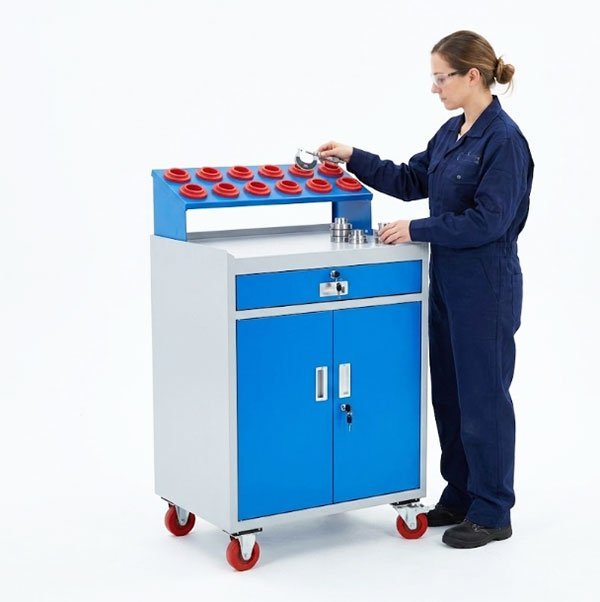
Casters: the part nobody specifies and everybody replaces
A cart is only as good as the four small parts under it. Buyers check drawer count and cabinet size, then accept whatever wheels come on the unit. That is the wrong way round.
| Caster detail | What it decides | What to check on the order |
|---|---|---|
| Wheel diameter | How easily the cart rolls over expansion joints, swarf and grated floors | 100 mm or 105 mm on our mobile models; smaller wheels jam on rough concrete |
| Load per caster | Whether a loaded cart can be pushed or has to be dragged | Ask for the rating per caster, not per cart |
| Wheel material | Noise, floor marking and chemical resistance | Suited to your floor and the oils or solvents in the workshop |
| Brake type | Whether the cart stays put while a drawer is open | Total-lock brakes on at least two casters |
Swarf is the fastest way to kill a caster: it works into the bearing race, the wheel stops turning, and the operator drags the cart, loading the frame in a way it was never designed for. Load height matters too — a cart that rolls easily when empty can feel unstable with three drawers open and a full top tray.
Slides wear with distance, not just weight
Drawer slides on a mobile cart live a harder life than the same slides in a cabinet on a wall. Every push across the floor sends a small shock through the drawer, the tool load shifts, and the slide takes a lateral hit it never sees on a static unit.
- Ball-bearing slides. We fit 45 mm ball-bearing slides rated for 50 kg per drawer. Friction slides that feel fine in a showroom bind once the cart is loaded and moving.
- Detents or a brake that holds drawers closed. A drawer that rolls open while the cart is being pushed is the most common complaint in workshops — and the most common cause of a damaged drawer front.
- Central locking. One lock that secures every drawer at once is what makes a cart safe to leave overnight in a shared shop.
- Check the slide screws at six months. Vibration loosens fasteners. Two minutes with a screwdriver is the difference between a cart that lasts five years and one that loses a drawer rail in year two.
Vibration finds every weak joint
Fatigue on a cart comes from thousands of small impacts, not from the weight in the drawers: a floor joint, a drawer slammed shut, a tool bag dropped on the top tray.
Three things to ask about before ordering:
- How the frame is joined. Continuous welds with a corner reinforcing rib are what survive years of being pushed around a shop.
- Whether the handle is welded or bolted. A bolted handle can be replaced; a welded one cannot, so it has to be strong enough for the way the shop actually uses it.
- What the top tray is rated for. The top is not decoration. On most shop floors it carries the heaviest single item in the whole cart.
Sizes and configurations that matter before you order
Height changes with what sits on top. The same body is taller with a pegboard panel than with casters only, which matters when the cart has to pass under a bench or through a workshop door.
| Configuration | Body size (W × D × H) | Total height with casters or panel |
|---|---|---|
| Single-drawer mobile cart | 630 × 400 × 630 mm | 735 mm with 105 mm casters |
| Single-drawer cabinet on wheels | 720 × 420 × 840 mm | 940 mm with 100 mm casters |
| Two-drawer cart with pegboard | 900 × 400 × 980 mm | 1,370 mm with a 390 mm pegboard panel |
Square-hole pegboard is the standard accessory in our range: 25 mm or 50 mm hole spacing, which decides whether the site’s existing hooks and holders will fit. Get that wrong and the site buys a second set of accessories locally, which is usually more expensive than the panel itself.
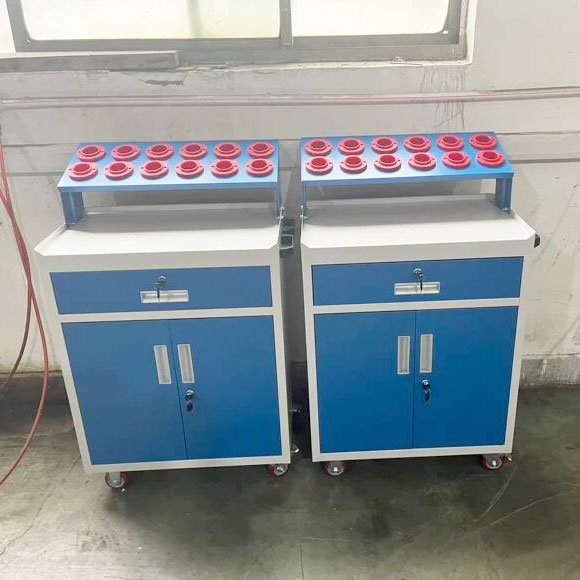
What gets left off the order
- Spare casters. Two or four per container. They are small, they are the part that fails, and air-freighting them later costs more than the parts.
- Brake type. Total-lock or plain swivel. Specify it, or the container arrives with whichever the line had in stock.
- Pegboard hooks and holders. Order them with the cart, or the panel sits empty.
- Drawer liners. Cheap to include, and they stop tools rattling every time the cart moves.
- Keying plan. One key per cart, or keyed-alike across a fleet. Decide before production, not after.
How these carts are built and checked
The carts run on the same steel line in Luoyang that produces the rest of our tool storage range. Bodies are cold-rolled steel with a powder-coated finish, pegboard panels are punched to a fixed 25 or 50 mm pitch, and every caster set is fitted and rolled before packing. Two details we record per batch: the slide model rated to each drawer, and the caster model with its load rating — which is what makes a spare order accurate a year later, when a workshop asks for a part without a number.
Custom work is routine: drawer counts, panel heights, colour matched to a site’s 5S floor markings, keyed-alike fleets. Send the shop layout, the tool list and the floor surface, and we will return the configuration and the spare list.
Common questions
How much can a mobile cart carry? It depends on the caster set, not the body. Work backwards from the total tool weight, top tray included, to the rating per caster.
Can I order the same cart without casters? Yes — the same bodies come as static cabinets with a plinth or levelling feet, the better choice for a unit that never moves.
Do the drawers lock when the cart moves? On locked carts, one key secures the whole unit. For shared areas, agree a keying plan before production.
What fails first in service? Casters, then slides, then the handle. Spares for all three travel in the same container.
What does the warranty cover? One year on the cart from delivery, with terms for bulk orders confirmed on the order along with the packing method.
The short version
On a mobile cart the failure starts underneath. Specify casters by diameter, load per caster, wheel material and brake type; keep ball-bearing slides at 45 mm rated 50 kg per drawer; and check that the catches and frame joints will take thousands of small impacts rather than one big load. Order the spares — casters, slides, hooks, liners — in the same container.
Send the shop layout, the tool list and the floor surface, and we will come back with the configuration, the spare list and a quote within 24 hours.
Flammable Storage Cabinet Venting — When Ducting Is Required and When to Leave Bungs In
Most flammable storage cabinets should stay sealed. NFPA 30 does not require venting for fire protection,...
Read articlePhone Charging Locker Specs — Bay Count, Power Draw and Lock Type Buyers Must Pin Down First
Three specs decide whether a container of phone charging lockers sells through or comes back as...
Read articleSteel Filing Cabinet Mistakes: 5 Specs That Ruin Office Storage Before the First Audit
Five filing cabinet specs that ruin office storage: slide ratings, lock type, drawer depth, coat thickness, and anti-tip design.
Read article