
Cassette vs Slide Storage Cabinet — Drawer Sizing, Capacity Math and Splitting the Archive
A wax block and a glass slide are not two versions of the same object. The block is the tissue; the slide is a section cut from it. That single difference decides how each one is stored, how many of them a cabinet holds, and — the part most labs work out late — why the two should not be kept in the same body.
Buy the wrong drawer and the blocks will not sit flat. Buy the wrong tray and the slides will not stand. But the failure that matters is quieter: put the source and the copy behind the same pair of doors, and one fire, one leak or one dropped shelf takes out both at once.
This guide covers what each format is sized on, the capacity figures that hold up in a real archive, and the two risks that decide where the cabinets go.
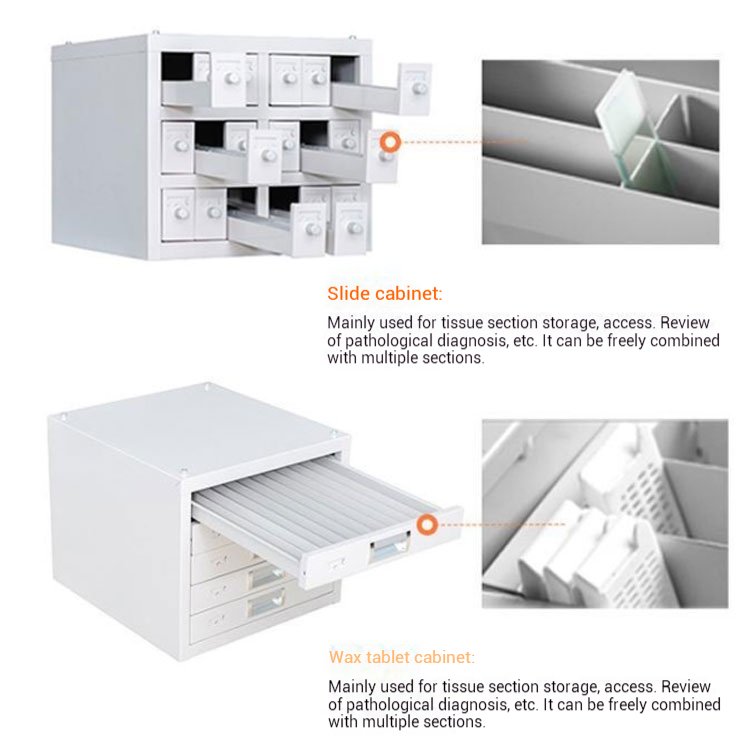
What each cabinet is actually holding
| Format | What it is | How it is stored | Sized on |
|---|---|---|---|
| Cassette / paraffin block | The source — embedded tissue that cannot be re-cut | Upright in cell dividers, tissue face forward | Drawer depth, cell pitch and the weight of a full drawer |
| Glass slide | The copy — a thin section, mounted and labelled | Flat in trays, label facing forward | Tray length, slot pitch and the fragility of glass |
A paraffin block is small and dense: roughly 7 mm of wax around the tissue, and a full drawer of them weighs far more than a drawer of anything else in the room. A slide is a glass rectangle with a coverslip and a label, and the label is what the lab actually reads. Neither drawer geometry suits the other, and a compromise drawer serves both badly.
The capacity numbers, per format
| Cabinet | Format | Per section | Four-section stack |
|---|---|---|---|
| Wax block, standard | Cassettes | 3,710 | 14,840 |
| Wax block, deep | Cassettes | 3,990 | 15,960 |
| Slide, vertical | Slides | 12,960 | 51,840 |
| Slide, flat | Slides | 1,650 | 8,250 |
Read the slide rows slowly. Vertical storage packs roughly eight times the slides into the same footprint as flat trays, which is why permanent archives run vertical. Flat storage is the opposite trade: fewer slides, but you can read a row and pull one without disturbing the rest — which is what a bench needs when the same twenty cases come back for review every week.
Most working labs end up with both: a dense vertical bank for the archive and a small flat unit at the bench. Sections can be used alone or stacked four high on a stainless base.
Why the two formats should not share a body
The obvious reason is the drawer. The stronger reason is redundancy. A block is the only copy of that tissue; a slide is a copy that can, within limits, be made again. Store them together and a single incident — a fire in the room, a leak from the floor above, a collapsed shelf — destroys the original and the copy in the same event. Split them, and the same incident costs the lab one of the two.
Argue it that way with whoever controls the budget: a divided drawer holds both formats, but it does not give the archive a second, independent copy.
Locks, and the cases that need one
Sections can be locked individually rather than as a whole unit. That matters in a shared room where the archive is not the only thing behind the door: routine cases stay accessible, while the medicolegal and forensic sections get their own key and their own access list.
A lock protects the archive from people — not from heat, water, or a technician who leaves the label off. Keep a key register, and treat that key as part of the case record.
Heat, water and the block you cannot re-cut
Paraffin is a combustible solid with a flash point around 199°C. An archive is therefore a fuel load: tens of thousands of cassettes in one cabinet is tens of kilograms of wax, and a room full of cabinets is a fire that will burn long after the ignition source is out. Wax does not always smoke before it ignites, so a smouldering start is easy to miss.
The nearer problem is heat. Paraffin softens from roughly 47°C upward. A storage wall shared with a boiler, an autoclave or a drying oven, or a cabinet in direct sun against a glazed wall, runs hot enough in summer to deform blocks. Deformed blocks stop sitting flat, the drawer stops closing cleanly, and the label lifts. Nothing dramatic — just an archive that slowly becomes harder to read.
Water is the other half. A wet block keeps its tissue but loses its label, and in most labs the label is how the block gets found. A wet slide is worse: the coverslip lifts and the section mounted on it is gone. Basement archives, cabinets under the staining bench, and any position below a sink or a riser are the three usual mistakes.
- Above flood level. Not the basement, not under a sink, not below a riser.
- Off the hot wall. No shared wall with a boiler, autoclave or drying oven, and no direct sun through glass.
- Out of the traffic path. An archive parked in a corridor collects trolley impacts it was never built for.
So state the limit honestly: a steel cabinet is not a fire safe. What protects an archive is position first — away from heat, above flood level — and duplication second. A scanned slide image costs almost nothing and covers the case where the glass does not survive.
How these cabinets are built
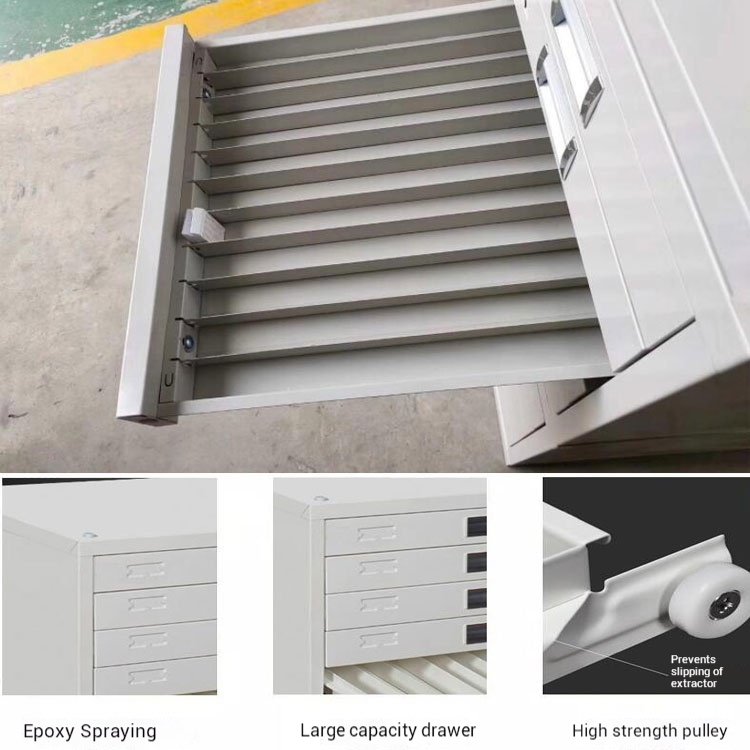
The cabinets run on the same steel line in Luoyang as the rest of our laboratory range: cold-rolled steel with a powder-coated finish, an internal label card slot on every drawer, and a stainless base that lifts the body off the floor and carries the earthing point. A four-section stack ships with the base as standard.
Common questions
Can one cabinet hold blocks and slides together? With a divided drawer, yes. But the drawer is not the point — kept together, one incident takes out both the source and the copy.
How many blocks does a four-section cabinet hold? 14,840 standard cassettes, or 15,960 in the deep version, which takes the same format in a taller body.
Why store slides vertically? Density — around 12,960 slides per section against 1,650 flat. Use flat trays where cases are pulled for review, and vertical storage for the archive.
Can a single section be locked? Yes. Sections lock individually, which is what medicolegal and forensic archives normally need.
Is a steel cabinet enough to protect the archive from fire? No. It is a steel cabinet, not a fire safe. Location and a duplicated record do more for the archive than the body does.
The short version
A cassette is the source and a slide is the copy, so they are sized differently and should not share a body. Blocks need drawer depth and cell pitch; slides need tray length and slot pitch. Check the capacity figure per section before you plan the room, keep the archive away from heat and above flood level, and lock the forensic sections individually.
Send the case volumes, the formats you store and the room layout, and we will come back with the cabinet combination, the base and a quote within 24 hours.
Knock-Down Steel Filing Cabinet — Flat-Pack Loading and the Container Math Importers Miss
Importers do not buy filing cabinets. They buy space on a ship, and the cabinet is...
Read articleESD Workbench Setup — Grounding and Surface Resistance Checks Before Your First Shift
A bench is only an ESD bench when three things check out: the worktop dissipates static,...
Read articleBoltless Steel Shelving Guide — Beam Pitch, Deck Type and How Load Ratings Actually Add Up
Boltless shelving is held together with keyhole slots and snap-in beams. There is no bolt, no...
Read article