
Welding Workbench Setup: Steel Top and Grounding for Shops — Built for Arc and Heat
A fabrication shop that uses a wooden workbench for welding gets a fire eventually. A fabrication shop that uses a steel workbench without grounding gets a shock eventually. The workbench is not just a surface in a welding shop: it is part of the electrical circuit, part of the heat management system, and part of the safety setup that keeps the shop running without incidents.
This guide covers the three things that make a welding workbench actually work in a fabrication shop: the steel top, the grounding system, and the heat management design that keeps the bench from warping under repeated thermal cycling.

Steel top: material, thickness, and flatness
The top of a welding workbench takes the heat, the spatter, and the clamping force. A thin steel top warps after a few months of MIG welding because the heat input expands the steel unevenly and the repeated expansion cycles bend the surface. The minimum thickness for a welding bench top is 6 millimeters for light fabrication and 10 to 12 millimeters for heavy structural work.
The material matters as much as the thickness. Mild steel is the standard because it is easy to repair: when the surface gets scarred from spatter and grinding, the shop hand can resurface it with a flap disc in twenty minutes. Stainless steel tops are an option for food-grade or pharmaceutical fabrication shops, but they cost more and are harder to resurface.
| Welding type | Minimum top thickness | Surface finish |
|---|---|---|
| Light MIG/TIG | 6mm mild steel | Mill finish, ground flat |
| Heavy MIG/structural | 10-12mm mild steel | Mill finish, stress-relieved |
| Stainless fabrication | 6-8mm 304 stainless | Brushed finish, passivated |
Grounding: the part that keeps the welder safe
The workbench top is part of the welding circuit. The ground clamp connects to the bench, and the current flows through the bench to the workpiece. If the bench is not grounded properly, the current finds its own path through the operator, and that path goes through the hands. A properly grounded bench has a dedicated ground stud welded to the underside of the top, connected to the building ground with a heavy-gauge copper cable.
The ground stud is the detail that separates a welding bench from a regular steel table. We weld a 10-millimeter copper stud to the underside of every bench top at the factory, and we include a 2-meter ground cable in the shipment. The stud is positioned so the ground clamp can reach it without stretching the cable across the work surface.
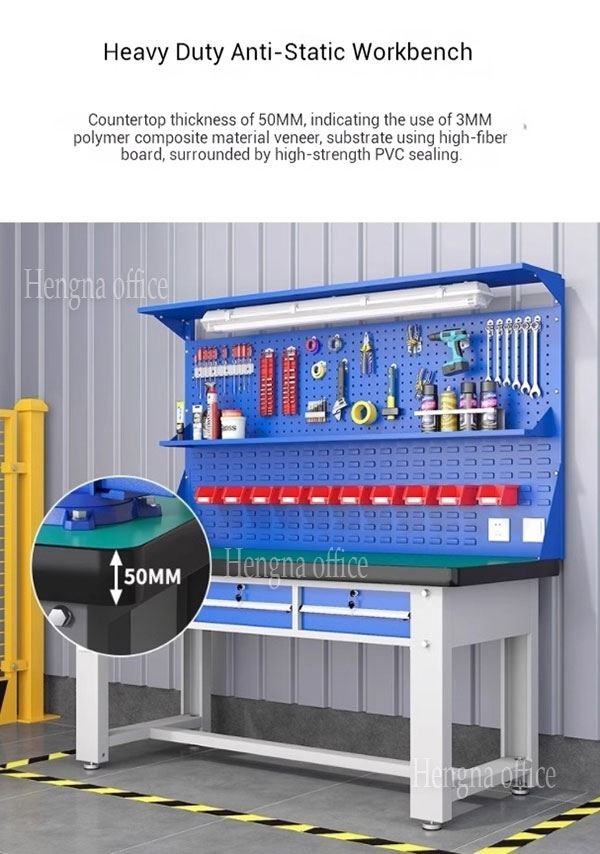
Heat management: preventing warp and keeping the surface flat
A steel top that is welded to a steel frame without expansion gaps will buckle when it heats up. The fix is a floating top design where the bench top sits on rubber pads or slotted brackets that allow the steel to expand without pushing against the frame. The pads also absorb vibration from grinding and reduce noise in the shop.
For shops that run continuous MIG welding for more than four hours a day, we recommend a ribbed underside on the bench top. The ribs stiffen the surface against thermal warping and add mass that helps the top cool evenly between welds. The ribs are welded at the factory and are invisible from the working surface side.
Vibration control and noise reduction
Grinding on a steel bench top sends vibration through the frame and into the floor, and the noise bounces off every wall in the shop. A bench that is bolted directly to a concrete floor transmits every vibration to the building structure, and in a multi-tenant shop that vibration becomes a complaint from the next unit. The fix is rubber isolation pads between the legs and the floor, and a floating top on rubber mounts that absorbs the vibration before it reaches the frame.
We include rubber pads with every bench shipment, and we offer a vibration-dampening top mount as a factory option for shops that share walls with offices or residential units. The pads cost almost nothing and the noise reduction is measurable: 6 to 8 decibels at the operator position in a standard grinding test.
Storage and organization under the bench
A welding bench without under-bench storage becomes a dumping ground for clamps, jigs, and consumables. A lower shelf rated for 500 kilograms holds the heavy fixtures, and a drawer unit on one end holds the small parts. We build both as integrated components that ship with the bench, not as add-on accessories that require separate assembly.
The drawer unit uses the same 45-millimeter ball-bearing slides as our tool cabinets, rated for 50 kilograms per drawer. The shelf is a 3-millimeter steel plate with a non-slip surface that keeps heavy fixtures from sliding when the bench vibrates during grinding. Both components are bolted to the frame at the factory and arrive as a single unit.
Common questions
Can the bench top be resurfaced after heavy use? Yes. Mild steel tops are designed to be resurfaced. A flap disc or a belt sander removes spatter and grinding marks, and the surface returns to flat. A 10-millimeter top can be resurfaced five to ten times before the thickness drops below the minimum for heavy work.
Do you offer a built-in welding table with a fume extraction slot? Yes. We offer a bench top with a slotted center section that connects to a fume extraction duct underneath. The slot captures welding fumes at the source and the duct routes them to the shop extraction system.
What is the load rating for the bench? Our standard welding benches are rated for 1,000 kilograms on the top surface and 500 kilograms on the lower shelf. For heavier loads, we offer reinforced legs and cross-bracing as a factory option.
Can the bench be mobile? Yes. We offer heavy-duty casters with a total lock as a factory option. The casters add 80 millimeters to the bench height and allow the bench to be moved around the shop. The lock holds the bench stationary during welding.
How do I specify the ground stud position? Tell us the shop layout and the welder position when you request the quote. We place the ground stud on the side closest to the welder so the ground cable does not cross the work surface.
Can the bench be used for both welding and assembly? Yes. Many fabrication shops use the same bench for welding and for final assembly. We offer a reversible top option where one side is a mill-finish welding surface and the other side is a machined flat surface for precision assembly. The top flips on a center hinge and locks in either position.
The short version
Steel top thick enough for the welding type, ground stud welded at the factory, floating top design that handles thermal expansion. Three things that turn a steel table into a welding bench. Send us the welding type and the shop layout, and we will return the bench spec with the quote.
Boltless Steel Shelving Guide — Beam Pitch, Deck Type and How Load Ratings Actually Add Up
Boltless shelving is held together with keyhole slots and snap-in beams. There is no bolt, no...
Read articleMobile Tool Cart Guide — Casters, Ball-Bearing Slides and the Parts That Give Out First
A tool cart and a tool cabinet do not fail in the same order. Put a...
Read articleFlammable Storage Cabinet Venting — When Ducting Is Required and When to Leave Bungs In
Most flammable storage cabinets should stay sealed. NFPA 30 does not require venting for fire protection,...
Read article