
Stainless Steel Cleaning Cabinet Guide: What a Janitor Closet Actually Needs
Stainless Steel Cleaning Cabinet Guide: What a Janitor Closet Actually Needs
A janitor closet is the most honest room in any building. The mop stands in a corner because there is nowhere to hang it. The buckets stack on the floor because there is no shelf. The cleaning chemicals crowd the sink because there is no storage at all.
A stainless steel cleaning cabinet fixes all three in one piece, and it usually pays for itself in the first month of not searching for things. Here is how to choose one that fits the closet you actually have, not the one in the catalog photo.
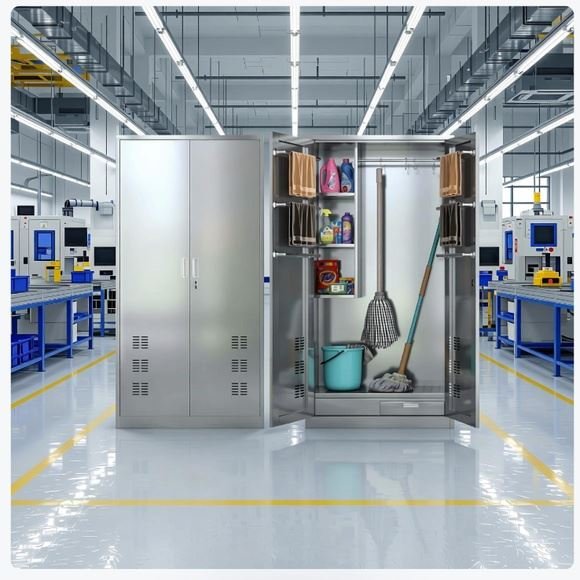
What a cleaning cabinet must hold
Before looking at cabinets, list what lives in the closet. The list decides the layout:
- Long tools: mops, brooms, squeegees, dusters
- Wet items: buckets, mop heads, cloths that need air
- Chemicals: bottles and sprayers that should be off the floor
- Small stock: gloves, bags, paper towels, spare parts
Each group needs a different space. Long tools need hanging height. Wet items need ventilation. Chemicals need a shelf with a lip or a tray. Small stock needs drawers or a lower cabinet. A cabinet that misses one of these becomes a metal box with the same mess inside.
Ventilation is the feature nobody lists and everyone needs
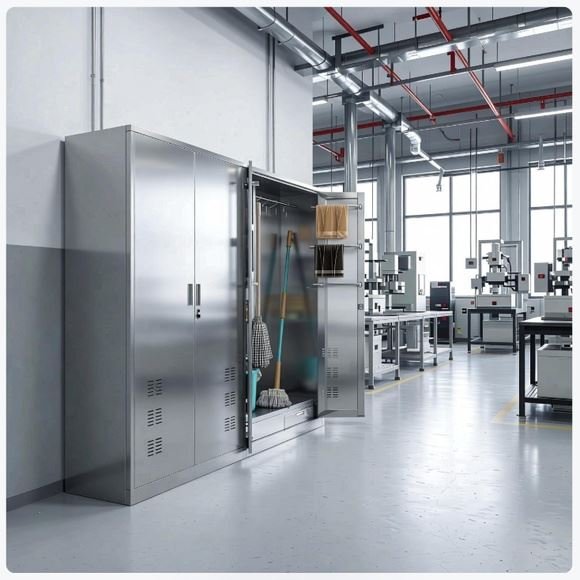
A closed steel cabinet holds yesterday rain mop smell by Friday. The fix is simple: louvered panels or perforated doors that let air move. Check that the vents are real openings, not stamped decoration, and place the cabinet where air can actually reach the vents. A vented cabinet pushed flat against a wall on both sides vents into nothing.
For wet mops, a removable drip tray under the hanging area catches the water instead of letting it pool on the cabinet floor. Look for a tray that slides out: a fixed tray that cannot be removed never gets cleaned properly.
Stainless steel: which grade, and why it matters
Cleaning chemicals and constant humidity are the two enemies of a janitorial cabinet. Stainless steel handles both, but the grade changes the story. 304 stainless stands up to bleach and floor chemicals for years. 201 stainless is cheaper and fine for dry storage rooms, but it will show rust spots in a constantly wet closet. For food plants, hospitals, and GMP rooms, 304 is the answer inspectors expect.
| Environment | Recommendation | Why |
|---|---|---|
| Hospital, food plant, GMP room | 304 stainless | Hygiene checks, bleach contact |
| Office building, school | 304 or coated steel | Daily use, moderate humidity |
| Dry warehouse storage | 201 stainless or coated steel | Low humidity, budget matters |
The layout that works in real closets
Most closets are narrow. Measure the door and the corridor before choosing a cabinet, because a 400 mm deep cabinet that turns a corner beats a 500 mm cabinet that does not fit through the doorway. Standard janitorial cabinets run 1800 mm high and 400 mm deep, with widths from 600 mm to 1200 mm depending on how many compartments you need.
Inside, the working layout is three zones: hanging space at the top for mops and brooms, shelves in the middle for chemicals and folded cloths, and a closed lower section for buckets and spare stock. A bottom drawer section replaces the closed section where small items are the bigger problem. We build both, and we also build split layouts with a lockable chemical compartment and an open tool section in one body.
Locks, keys, and the reality of shared closets
Cleaning chemicals are a control point in schools and care facilities, so the chemical compartment gets a lock while the tool section stays open for daily access. Think about who opens what before ordering: a shared key system across every closet in the building saves the facilities manager a drawer of mystery keys later. Tell us the keying plan at the quote stage, because locks are fitted at the factory, not on site.
Buying for multiple floors: keep the closets consistent
A building with ten janitor closets should have ten closets that work the same way. The cleaner who works the third floor on Monday and the sixth on Tuesday should open the same cabinet layout in both. Decide the standard cabinet once, then repeat it on every floor: same width, same zone layout, same keying, same drip tray position. Exceptions create workarounds, and workarounds create mess.
For multi-floor buildings we ship numbered sets with matching layouts and a shared master key. The facilities manager gets one reference sheet showing the cabinet plan for every floor, so training a new cleaner takes one walkthrough instead of ten.
How we build ours
Cleaning cabinets come off the same stainless production line in Luoyang that builds our lab and food-grade equipment. Welds are ground smooth because cleaning staff wipe down the cabinet every day, and a rough weld edge is a cut waiting for a hand. Door corners are folded, hinges are continuous, and the drip tray is a removable piece, not a welded tray you cannot clean.
Custom requests are routine: extra hooks, different shelf heights, a soap dispenser bracket, a bag holder on the door. Send the closet photo with measurements, and we will draw the cabinet around the pipes and the light switch that are always in the way.
Common questions
What size do most janitor closets need? A 900 mm wide double-door cabinet with a top hanging section and lower shelves covers a typical office or school closet. Wider closets take 1200 mm units with an added lockable chemical compartment.
Does the cabinet rust in a wet closet? 304 stainless does not rust under normal cleaning chemicals. 201 stainless can develop surface spots in a constantly wet room, which is why we ask about the room humidity before quoting the grade.
Can the chemical compartment lock separately? Yes. Split layouts with a lockable side for chemicals and an open side for tools are our standard custom build for schools and care homes.
Do you make cabinets with drainage? Yes. The drip tray can include a drain outlet that connects to a floor drain. Tell us the drain position and we place the outlet to match.
Can you match other stainless furniture we already have? Yes. Send a photo of the existing units and we match the finish, handle style, and vent pattern so the new cabinet does not stand out in the row.
Should the cabinet be wall-mounted or freestanding? Freestanding is the standard. Wall-mounted units work for narrow closets, but check the wall load first: a loaded cabinet with wet mops is heavier than it looks. Most buildings order freestanding and add a wall anchor strap for safety.
How long does a stainless cleaning cabinet last? In normal use, the cabinet body outlasts the building renovation cycle. The parts that wear first are the drip tray and the door seals, which is why we make the tray removable and the hinges continuous, so worn parts get replaced instead of the whole cabinet.
The short version
List what the closet holds, give every group its own zone, and choose 304 stainless anywhere the mops dry indoors. Measure the doorway, plan the keying before the quote, and send us the closet photo. The cabinet that fits your actual closet beats the one that fits the catalog.
Pathology Wax Block Cabinet Guide: Drawer Depth and the Detail Labs Get Wrong
Drawer depth, label systems, and retention math for patient record archives.
TCM Medicine Cabinet Guide: How Many Drawers Does a Pharmacy Actually Need?
Count the herbs, multiply by 1.3, and order that many drawers.
How to Choose Steel Filing Cabinets and Wardrobe Lockers for Offices, Schools, and Factories
Drawers for paper, vents for coats: choosing steel storage room by room.