
How to Choose Steel Filing Cabinets and Wardrobe Lockers for Offices, Schools, and Factories
How to Choose Steel Filing Cabinets and Wardrobe Lockers for Offices, Schools, and Factories
A filing cabinet and a locker look like the same piece of steel furniture until you try to use one for the other job. Put staff uniforms in a filing cabinet and the drawers jam on hangers. File employee folders in a locker and the papers stand up wrong, bent at the corners.
This guide walks through both product lines: what to check when you buy filing cabinets for an office, and what to check when you buy wardrobe lockers for schools and factories. The requirements are different, and so are the mistakes buyers make.
The two products, side by side
| Feature | Steel filing cabinet | Wardrobe locker |
|---|---|---|
| Purpose | Paper files, folders, office documents | Coats, uniforms, bags, personal items |
| Typical drawers | 2 to 4 drawers, suspension file rails | No drawers, one hanging rod and hooks |
| Lock | One central lock, all drawers lock together | Individual door lock per compartment |
| Ventilation | Not needed | Vents or louvers, or the locker smells |
| Common buyer | Office manager, records department | School, factory, staff room |
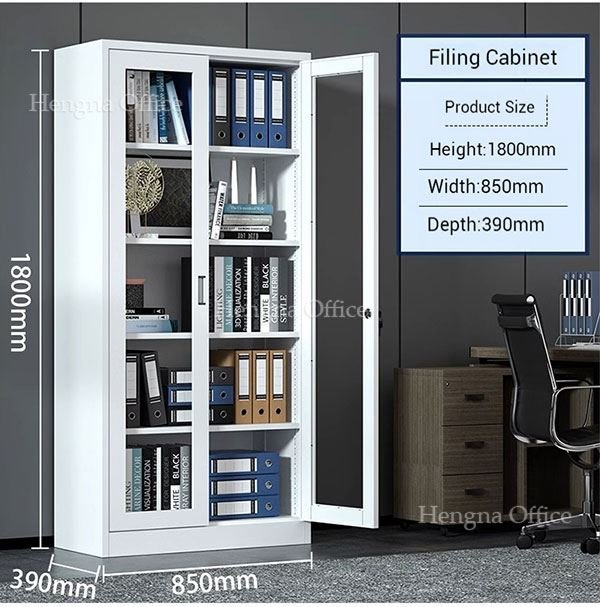
For offices: how to choose a filing cabinet
Start with what goes inside. A4 files, A4 hanging folders, or legal-size documents decide the drawer depth before anything else. Check the internal width of the drawer, not the outside width of the cabinet. Two cabinets can look identical from the outside and differ by 40 mm inside, which is the difference between files fitting flat and files going in diagonally.
Drawer count. Two-drawer cabinets sit under desks and work as printer stands. Three-drawer units are the standard office choice. Four-drawer cabinets pack more paper per square meter but get heavy when full: a loaded four-drawer cabinet can weigh more than one person can shift, so plan the layout before it arrives.
Drawer slides. This is where cheap cabinets show themselves. A drawer that opens on plain metal runners will bind when loaded with a full row of files. Ball-bearing slides open the same way empty or full, and they are the first thing we upgrade when a customer complains about a previous supplier. Test a loaded drawer before you order a container of them.
The lock. One key locking all drawers at once is standard. Some offices need per-drawer locks, or a shared keying system where one key opens every cabinet in the building. Tell us before production: keying is set at the factory, not in the office.
Finish. Powder coating in gray, black, or white covers most offices. The coating on the drawer fronts takes daily contact, so ask whether the supplier uses epoxy powder or a cheaper paint line. Scratched drawer fronts are the first visible sign of a cabinet two years in.
For schools: how to choose wardrobe lockers
School lockers live a harder life than any office cabinet. Students slam doors, spin locks, hang wet coats, and stuff bags into spaces a size too small. The buying decisions follow from that.
Compartment size. One compartment per student, one to two hanging hooks, and space for a school bag at the bottom. Multi-door layouts let you configure tall and short compartments in one locker body, which solves the classic problem of mixed age groups in one school.
Ventilation is not optional. A locker without vents holds yesterday rain jacket smell by Friday. Louvers on the door front cost almost nothing at the factory stage and save a hundred complaints later. Check that the vents are real openings, not painted decoration.
Locks. Padlock hasps are the simple standard. Built-in key locks reduce lost padlocks, and electronic locks suit schools that want central control. For staff rooms, key locks on every door, with a master key for the administration office.
Door construction. Door corners should be folded, not raw cut edges, and the door should close square against the frame. Slam it a few times in the showroom: a hollow rattle means thin steel and loose hinges, and both get worse with student use.
For factories: lockers that work in workwear
Factory staff rooms need locker bodies that handle oil, dust, and wet clothes. Stainless steel doors or full stainless lockers are the usual answer near production lines. For a changing room that is a hundred meters from the workshop, powder-coated steel works and costs less.
Number the compartments, weld the hasps on rather than riveting them, and order spare keys at the same time as the lockers. Replacing a lost padlock is easy; re-keying fifty built-in locks later is not.
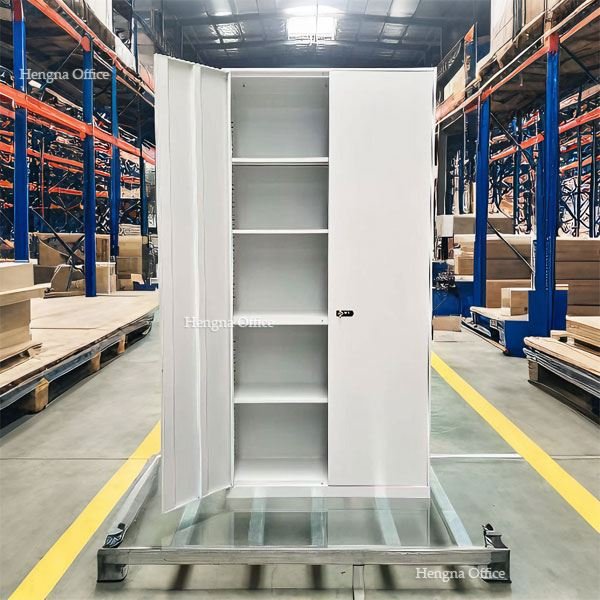
One more check that applies to both
Measure the doors the furniture has to pass through. A four-drawer filing cabinet and a six-door locker are both wider than a standard office door frame when turned the wrong way. We ship knockdown where the site access is tight, and assembled where the buyer wants cabinets out of the box and into place the same morning. Both options exist on the same product; decide before the quote.
How we build both lines
Filing cabinets and wardrobe lockers come off the same production line in our Luoyang factory: the same cutting and bending, the same welding stations, the same powder coating line. What differs is the hardware set, and that is where the quality questions live. Drawer slides, hinges, lock bodies, and hasps are the parts that fail first, so we fit the better hardware by default and make the cheaper hardware an option, not the other way around.
Colors, dimensions, and compartment layouts are made to order. OEM buyers bring their own specifications: school districts often repeat a locker design across five campuses, and offices order filing cabinets to match an existing fit-out from years ago. Send the reference photo and we match it.
Common questions
Can one cabinet be used as both a filing cabinet and a wardrobe? No. The internal hardware is different: suspension rails versus hanging rods. Forcing one product into the other role leads to jammed drawers and bent files. Order the right product per room.
What is the minimum order? A mixed container is the standard first order, and we combine filing cabinets, lockers, and other steel furniture in one shipment to fill it.
How do we handle keys across a large order? Keying is planned at production: all-different, all-same, per-block, or master-key systems. Give us the floor plan and the keying rules before production starts.
Do you offer knockdown versions? Yes. Knockdown saves freight volume on full containers and gets furniture through narrow doors. Assembled versions ship for buyers who want plug-and-play installation.
Can you match an existing color or brand? Yes. Send the color reference or the existing cabinet photo, and we match the powder coat and can add your brand marks on the doors.
How do I know the drawer will hold a full row of files? Ask the supplier for the drawer load rating and check the slide type. Ball-bearing slides with a rated load of 30 kg or more handle a full drawer without sagging, and that is the number we print on our spec sheets.
The short version
Filing cabinets are about drawers, slides, and keying. Wardrobe lockers are about compartments, ventilation, and locks that survive students. Measure your doors, test a loaded drawer, and decide knockdown or assembled before you quote. Then send us the floor plan: we will lay out both products and price them in one reply.
How to Choose High-Density Employee Lockers: Steel 12-Door Knockdown Guide
Door count, ventilation, and frame gauge: what matters when you outfit a hundred-person locker site.
Steel Office Furniture Design: Insights from Bruceton
How our designers turn a sketch into a steel office furniture product specification.
Workshop Organization Solutions: Perforated Panel Tool Systems
Why pegboard layouts fail in workshops, and how a steel perforated panel system fixes tool organization.