
Phone Charging Locker Specs — Bay Count, Power Draw and Lock Type Buyers Must Pin Down First
Three specs decide whether a container of phone charging lockers sells through or comes back as a complaint: how many bays, what the cabinet draws when every bay is full, and which lock the people on site can actually operate. Get those three wrong and the rest of the order does not matter.
This is written for importers, wholesalers and fit-out contractors. The end user asks “how many phones fit”. Your question is different: what goes on the order sheet so nobody has to open the cabinet twice, and so the spare parts box that arrives with it is the right one.
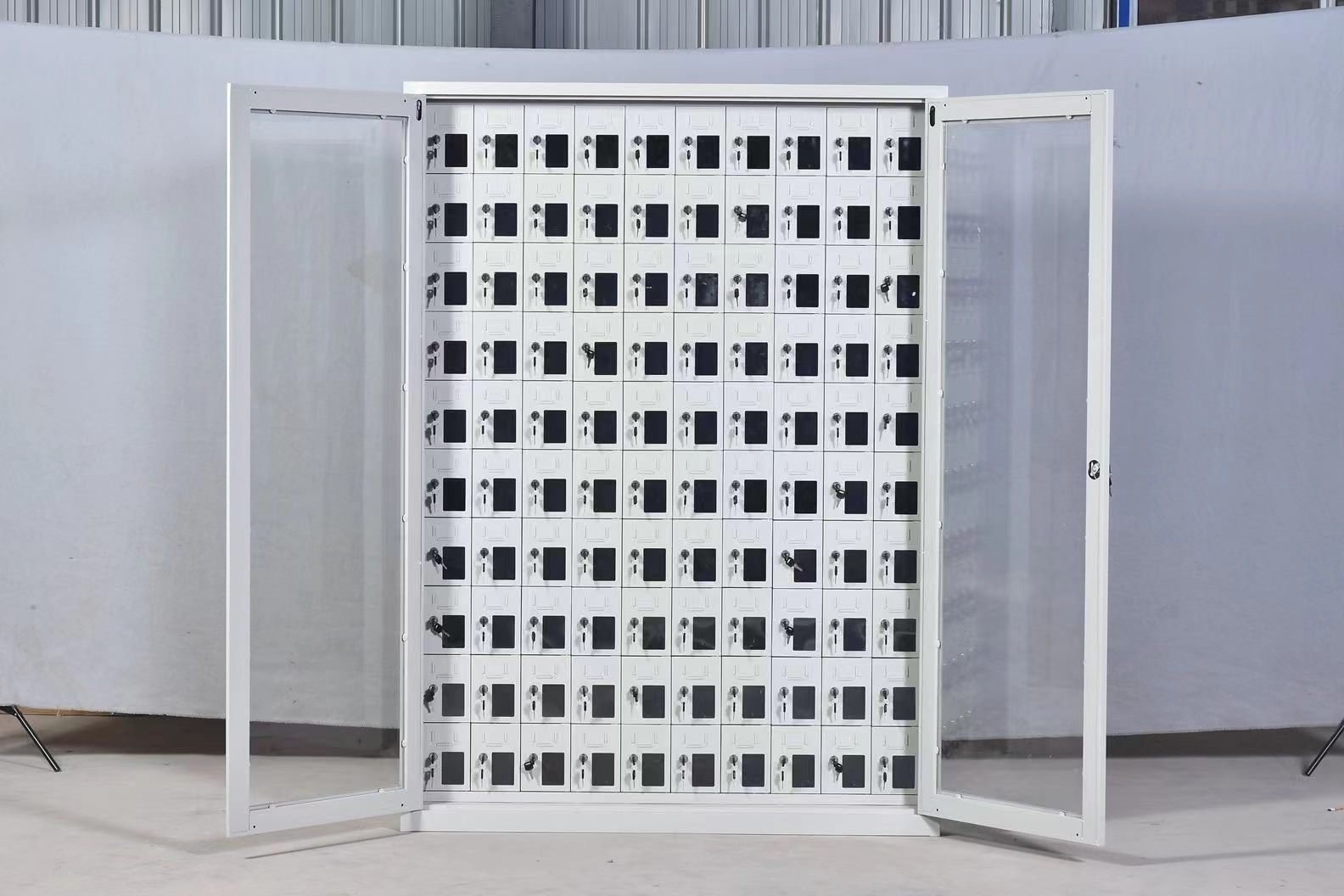
Bay count: work back from the roster, not the price list
Most buyers pick a bay count off a catalogue page and then find out the site needs a different number. Start from the way the building actually runs.
- Peak hour, not headcount. A site with 300 staff may only have 90 phones in the building at any one time.
- Shifts multiply the demand. A factory running two shifts needs changing-over space, not double the bays.
- Leave 15–20% empty. Full cabinets from day one turn into a queue the first time a device is left behind overnight.
| Site type | What drives the number | Bays that usually fit |
|---|---|---|
| Office floor | Phones left behind during meetings and site visits | 40–50 |
| Factory, two shifts | Roster per shift plus a changeover buffer | 60–70 |
| Gym or pool reception | Members per peak hour, wet hands, no keys wanted | 24–36 |
| Training centre or exam hall | Seats in the largest room | one bay per seat |
Bays are quoted per cabinet, and sites order in banks. A single 48-bay cabinet and two 24-bay cabinets hold the same number of phones but need different walls and door clearances, so ask for outer dimensions before you promise a layout.
Power draw: the number that decides the circuit
Two figures get mixed up here, and they are not the same thing. The first is per-bay charging current: the module in these cabinets delivers 5 volts at up to 2.4 amps per bay, which brings a phone from flat to full in roughly two hours. The second is what the whole cabinet pulls when every bay is occupied at once.
| Bays | DC load on the low-voltage side | What to confirm with the supplier |
|---|---|---|
| 6–24 | up to about 290 W | Voltage and plug type for the destination market |
| 32–48 | up to about 580 W | Rated input of the power supply, not just the DC output |
| 64–100 | up to about 1.2 kW | Switch-on surge, and whether the module throttles when all bays are live |
Three things worth writing into the spec sheet. One: the cabinet should not share a final circuit with kettles, air conditioning or workshop machinery. Two: ask whether power management is per bay or shared — with shared management, one device pulling hard can slow every other bay in the row. Three: heat. A full cabinet with the doors closed runs warm, and warm modules cut charging current. Ventilation type belongs on the order, not in a later email.
Lock type: decide who holds the keys before you order
Lock type is an operating decision disguised as a hardware decision. Ask who uses the bays and how the site supervises them, then pick from there.
- Individual key per bay. Staff keep their own key. Order numbered keys and a master key, or the site will lose the numbering in the first month.
- Keyed-alike row. One key opens every bay in a cabinet. Simple for supervised sites, unsuitable where phones are left overnight.
- Combination lock. No keys to lose, shared bays between shifts. Tell the operator the code each time, or write it on the bay label.
- Electronic access. PIN or card entry. Worth having if the building already runs an access system — but confirm it at the specification stage, because it changes the control board and the lead time.
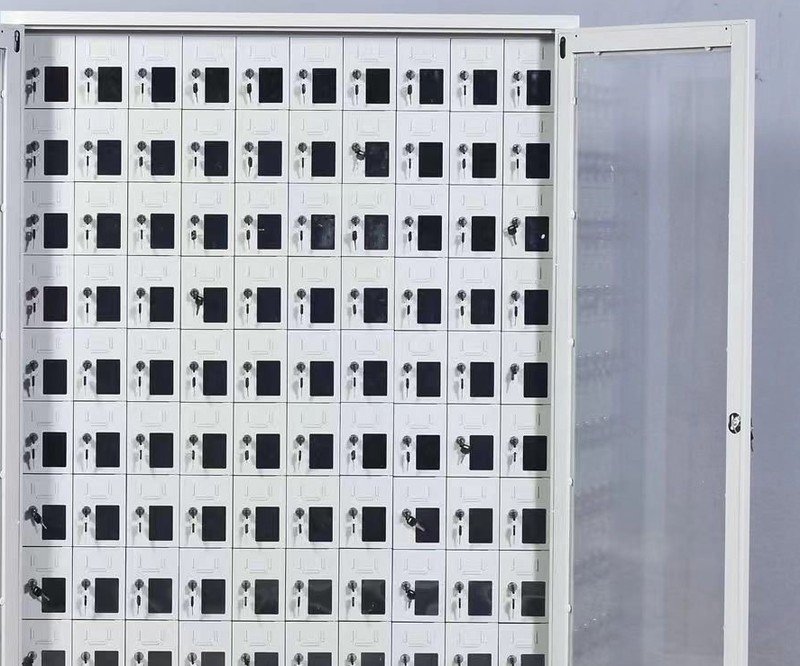
Whatever you choose, order the bay labels and a set of spare keys with the cabinet. A lost key turns a working site into a call to your office, and bay numbering is what lets a site manager find one phone in a row of 48.
Cabinet and bay sizes that have to match the site
| Item | Specification |
|---|---|
| Bay count per cabinet | 6 to 100 |
| Bay sizes | 150 × 150 mm, 120 × 150 mm, 150 × 120 mm |
| Cabinet depth | 300 mm; 350 mm on the glass-front version |
| Body | Steel body with a powder-coated finish |
| Door options | Solid steel doors or glass front with a separate outer door |
Depth catches people out: a 350 mm glass-front cabinet is wider once the outer doors swing, so check the corridor and the wall return before confirming a layout.
What goes on the order sheet
- Bay count and bay size
- Voltage and plug type for the destination market
- Per-bay charging current
- Lock type and the keying plan
- Bay numbering and site labels
- Colour, and solid door or glass front
- Spare keys and spare charging modules
- Packing and carton marking
How these cabinets are built and checked
The bodies come off the same steel line in Luoyang that runs the rest of the commercial locker range we supply. The charging modules come from established suppliers and are fitted and load-tested on every bay before packing, so the cabinet arrives as a working unit rather than a locker plus a box of sockets.
Two details we record and can pass on with the order: the module model and the per-bay current it was set to. That is what makes a spare module useful twelve months later.
Custom work is routine: bay counts from 6 to 100, mixed bay sizes in one cabinet, colour matching for a chain, and glass or solid doors. Send the site layout, the roster and the destination market, and we will come back with the configuration and the spare list that fits it.
Common questions
Can one cabinet serve two shifts? Yes, with a changeover gap. Two shifts sharing 48 bays works when the day shift clears out before the night shift starts. If the shifts overlap, order for the peak, not the headcount.
Do the bays charge phones and tablets together? The bay has to fit the device. Tablets need the deeper bay size, and mixing tablets into a row of phone bays is the most common fitting complaint we see on site.
What about locks with a master key? Standard on keyed orders. Tell us at the specification stage whether the site wants one master per cabinet or one master across a bank of cabinets.
Can I order spare keys and modules with the container? Yes, and it is cheaper than air-freighting them later. Keys are light; modules travel in the same carton as the cabinet.
What does the warranty cover? One year on the cabinet and the charging modules from delivery. Warranty terms on bulk orders are confirmed on the order, along with the packing method.
The short version
Pin down three things before the container is booked: bay count measured against the site’s peak roster, the cabinet’s full-load draw and the plug type for the market you are selling into, and a lock type matched to how the site is supervised. Everything else — colour, labelling, spare modules — is detail that goes on the order sheet, and gets harder to fix once the goods are at sea.
Send the site layout, the bay count and the destination market, and we will come back with the configuration, the spare list and a quote within 24 hours.
Steel Filing Cabinet Mistakes: 5 Specs That Ruin Office Storage Before the First Audit
Five filing cabinet specs that ruin office storage: slide ratings, lock type, drawer depth, coat thickness, and anti-tip design.
Read articleLocker Room Upgrade: Before vs After Steel Wardrobe Lockers for Gyms and Staff Areas
Before vs after steel wardrobe lockers: moisture, hinges, locks, and ventilation compared for gyms, pools, and staff changing rooms.
Read articleDevice Charging Cabinet Guide: How Many Slots a 50-Student Classroom Actually Needs
Slot count math, charging speed, ventilation, and lock type: what a 50-student classroom actually needs from a device charging cabinet.
Read article