
Janitorial Chemical Storage — Spill Trays, Shelf Loads and What Inspectors Actually Check
A chemical store rarely fails because somebody mixed two products on purpose. It fails because a cap was not quite tight, a container split, and the two liquids ran together in a cabinet nobody opens between shifts.
Bleach and an acid bowl cleaner are enough. So are bleach and an ammonia glass cleaner. Neither pair reacts quietly, and a closed closet concentrates whatever comes off them. The cabinet’s job is not to look tidy: it is to hold incompatible classes apart, catch the leak before it reaches the floor, and let the air move.
This guide is for buyers specifying that cabinet: what cannot share a shelf, how much a spill tray has to hold, and where the weight belongs.
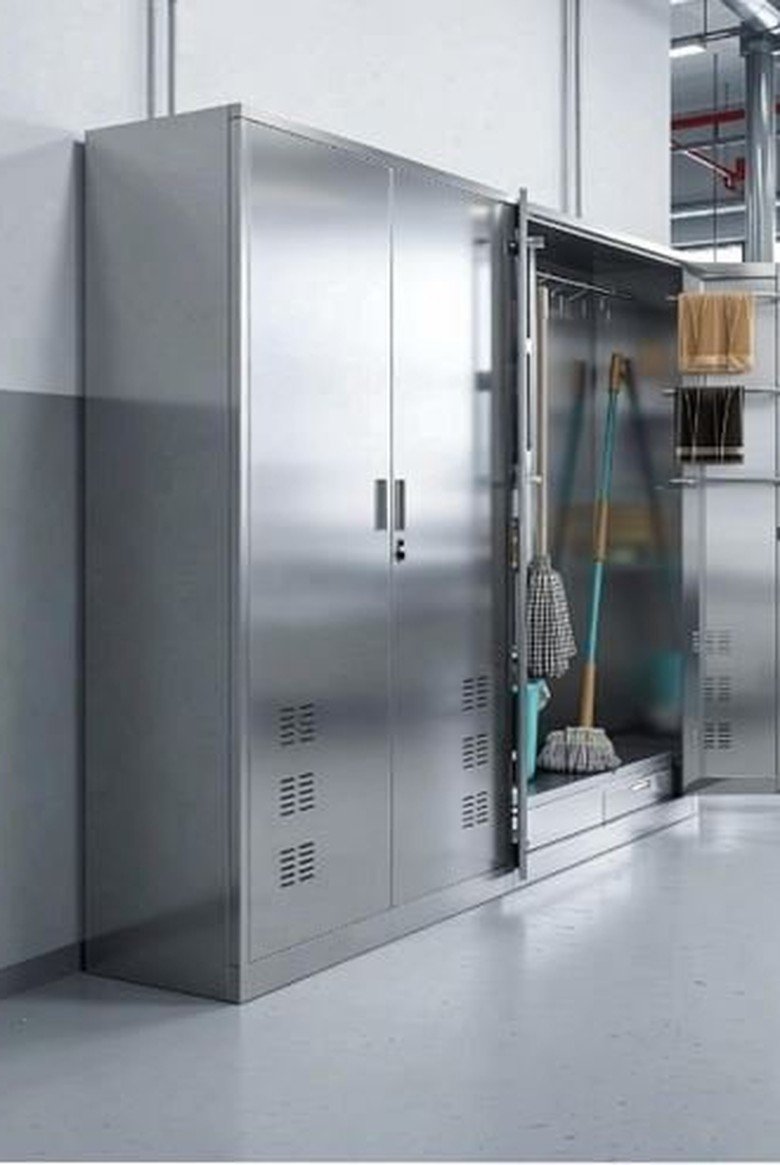
The pairs that cannot share a shelf
Cleaning inventories are built from three families that do not sit well together: chlorine products, acids, and ammonia or quaternary ammonium compounds. Most closets stock all three.
| Pair | What a leak produces | Storage rule |
|---|---|---|
| Bleach + acid bowl cleaner or descaler | Chlorine gas | Acids on a separate shelf, in a tray, at the bottom |
| Bleach + ammonia glass cleaner | Chloramine gas | Separate sections, never the same shelf |
| Peroxide above 8% + solvent or floor finish | Accelerated fire risk | Oxidisers away from flammables and finishes |
| Ammonia + an oxidising acid | Shock-sensitive ammonium salt crystals | Never in the same cabinet |
That is the common list, not the whole list. The authority for a specific pair is Section 10 of the product’s safety data sheet, which names the materials that product must not meet. Where the sheet is stricter than the general rule, the sheet wins.
Two signs tell you a store is laid out wrong: white crystals around the caps, and rust on metal containers — both mean two products have been reacting in the vapour for months.
How much a spill tray has to hold
The containment rule most auditors apply: the tray under a group of containers must hold 110% of the largest single container on that shelf — not the average, and not the total, because a drum that fails empties completely.
| Container | Full weight, about | Tray to specify |
|---|---|---|
| 750 ml spray bottle | 0.8 kg | 1 litre |
| 5 litre bottle | 5.5 kg | 6 litres |
| 20 litre jerry can | 22 kg | 22 litres |
| 25 litre drum | 26 kg | 28 litres |
Two details decide whether the tray works. It has to lift out, because a fixed tray never gets cleaned and becomes a reservoir of its own. And it belongs under the acids as much as the bleach — acid that drips has already started on the steel underneath.
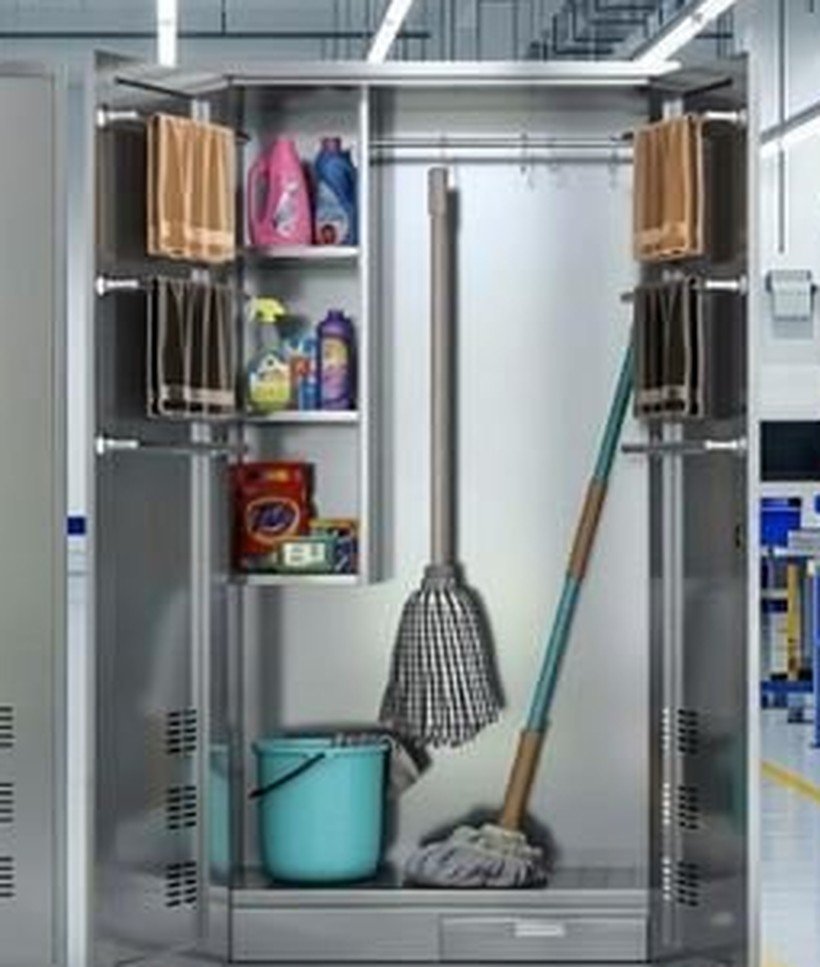
Where the weight goes
Loading matters as much as contents. A 25 litre drum weighs 26 kg, and by the third month nobody lifts it — they drag it off a shelf at waist height and put it back wet.
- Heavy containers on the lowest shelf. Drag distance should be as close to zero as possible.
- Nothing above eye level but light bottles. A dropped drum at head height is a lifting injury and a spill at once.
- Ask for the per-shelf rating before you load to the top. The number that matters is the lowest one on the unit, not the highest.
- Do not stack spray bottles. The bottom bottle takes the load and the cap is what fails.
Adjustable shelving is where that pays off: on a 1,800 mm body, spacing follows the containers — 300 mm between the two upper shelves for bottles, more below for drums. Ask for the spacing that fits the inventory, not the catalogue default.
The cabinet is not a sealed box
A closed steel cabinet holding bleach and floor stripper builds vapour, which is why the door and back panel carry louvred vents — they keep the cabinet from turning into a fume vessel.
Vents are not ventilation of the room. If the closet stores volatile products, the room needs mechanical exhaust to outside — usually quoted at around six air changes an hour. A louvred door is not a fan.
Quaternary ammonium concentrates release amine vapours slowly, and those corrode exposed stainless shelving and nearby copper pipe. Shelving speckled brown at the back of a two-year-old closet means the products were incompatible, or the air was not moving.
What the acid does to the steel
| Grade | Suits | Watch out for |
|---|---|---|
| 201 stainless | Dry stores, light cleaning products | Chlorides and dried acid residue pit it fastest |
| 304 stainless | Daily bleach contact, humid rooms, wash-down | Strong acids still attack it; rinse residue, do not let it dry |
| Coated steel | Dry stores, mild products | A scratch lets acid spread underneath the coating |
One honest limit: neither 304 nor 316 suits concentrated hydrochloric acid. 316 resists it better because of its molybdenum content, but “better” is not “suitable”. Strong acids belong in a polypropylene cabinet — a different line altogether.
Labels, the register and the person who opens the door
Layout does the heavy lifting, but three habits finish the job: every decanted bottle carries a label, the safety data sheets stay at the cabinet rather than in an office filing system, and the register is updated when the products change — because the segregation plan was built from that list.
The lock is there to keep products away from people who did not read the sheet. A keyed lock is enough, provided the key lives with a named person rather than on a hook.
How these cabinets are built
The cabinets run on the same steel line in Luoyang as the rest of our storage range: export body 500 × 400 × 1,800 mm with feet, in 201 or 304 stainless, double door, keyed lock, louvred vents and adjustable shelves, knocked down for shipping and assembled with hand tools on site.
Two details travel with the order: the stainless grade the batch was built to, and the shelf spacing it left the factory with — what makes a reorder six months later match the first shipment.
Common questions
Can bleach and a toilet cleaner share one cabinet? Yes, in separate sections with the acid in a tray on the lowest shelf. On the same shelf, no.
How big does a spill tray have to be? 110% of the largest container on that shelf — a shelf of 5 litre bottles needs 6 litres, a 25 litre drum needs 28.
Is a louvred door enough ventilation? For the cabinet, yes. For a room full of volatile products, no — that needs mechanical exhaust to outside, usually quoted at around six air changes an hour.
Will the cabinet rust in a wet closet? 201 holds up in a dry store; specify 304 where bleach and wash-down are daily. Rinse acid residue rather than letting it dry on the shelf.
Can acids be stored in a steel cabinet at all? Dilute household products, yes, in a tray. Concentrated hydrochloric acid belongs in a polypropylene cabinet.
The short version
A chemical store is a segregation plan first and a cabinet second. Keep bleach from acids and from ammonia, put acids in a removable tray sized to 110% of the largest container on the lowest shelf, load heavy drums low, and give the cabinet air. Layout matters more than material — until an acid finds a scratch.
Send the chemical list, the container sizes and the room dimensions, and we will come back with the layout, the tray list and a quote within 24 hours.
Cassette vs Slide Storage Cabinet — Drawer Sizing, Capacity Math and Splitting the Archive
A wax block and a glass slide are not two versions of the same object. The...
Read articleKnock-Down Steel Filing Cabinet — Flat-Pack Loading and the Container Math Importers Miss
Importers do not buy filing cabinets. They buy space on a ship, and the cabinet is...
Read articleESD Workbench Setup — Grounding and Surface Resistance Checks Before Your First Shift
A bench is only an ESD bench when three things check out: the worktop dissipates static,...
Read article