
Acid Cabinet vs Flammable Cabinet: Can They Share a Cabinet? What Inspectors Check
Acid Cabinet vs Flammable Cabinet: Can They Share a Cabinet? What Inspectors Check
An inspector walked into a teaching lab, opened one yellow safety cabinet, and stopped. Inside were ethanol bottles, acetone, and three bottles of hydrochloric acid sitting on the same shelf.
He did not write a fine. He wrote a list: move the acids, replace the corroded shelf, label every bottle, and show me the grounding wire. The lab manager asked us later what the acids had done wrong. The answer is simple: acids and flammables do not share a cabinet, and the shelf was already showing why.
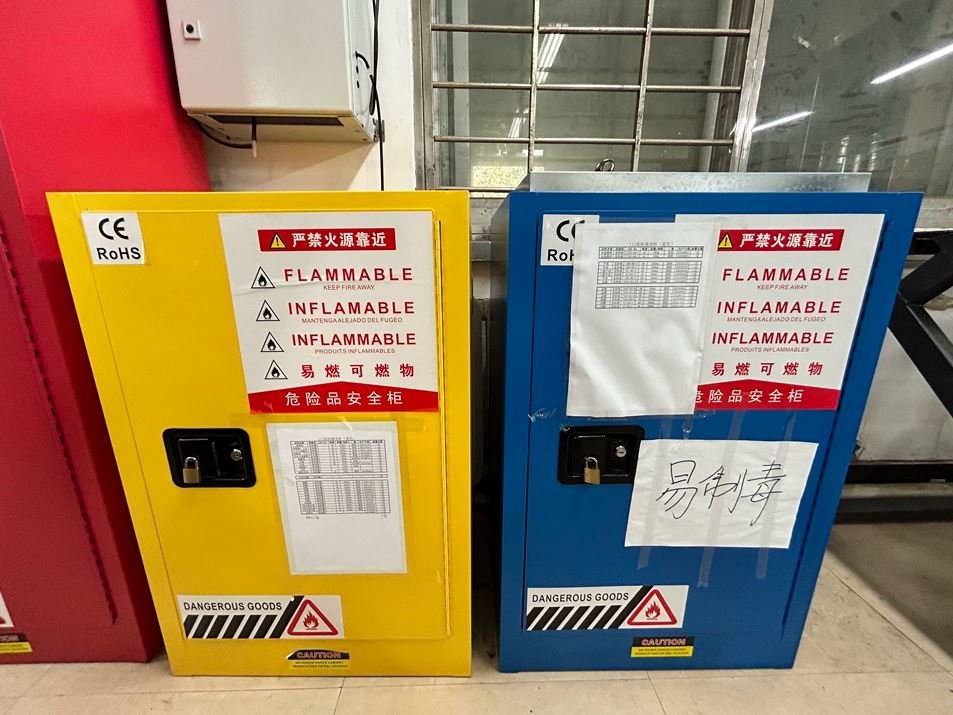
Why acids and flammables do not share a cabinet
Three reasons, and each one shows up in real labs.
Acid vapors eat the cabinet. Hydrochloric acid fumes are corrosive. In a closed cabinet they attack steel shelves, hinges, and the labels on the bottles. A yellow cabinet with a rusted shelf and peeling labels is almost always a cabinet that has been storing acids. The cabinet survives. The safety markings do not, and a cabinet with unreadable labels fails inspection on its own.
Some combinations react. Nitric acid and organic solvents are the classic pair. Keep them close, and the fumes alone can form compounds you do not want in an enclosed space. The general rule used in labs is simple: flammables with flammables, acids with acids, oxidizers on their own.
Emergencies are different. A flammable fire wants water mist and foam and the cabinet sealed. An acid spill wants the liquid contained and neutralized, and the cabinet opened by someone wearing the right gloves. Storing both in one cabinet makes both situations harder to handle safely.
The three-color system
Most labs around the world organize chemical storage cabinets by color. OSHA and NFPA do not write the colors into law, but the practice is so widely accepted that inspectors expect it.
| Cabinet color | Stores | Examples |
|---|---|---|
| Yellow | Flammable liquids | Ethanol, acetone, IPA, thinner, gasoline |
| Red | Combustible liquids | Paints, inks, diesel, motor oil |
| Blue | Corrosive liquids | Hydrochloric acid, sulfuric acid, nitric acid, sodium hydroxide |
Buyers in export markets read the color before they read the label. A yellow cabinet next to a blue cabinet tells the whole storage story in three seconds, and that is exactly what an inspector wants to see.
What inspectors actually check
Inspections vary by region, but these six points come up in almost every lab visit we hear about from customers.
1. Separation. Flammables and corrosives in separate cabinets. If space allows, the cabinets sit apart from each other.
2. Labels. Every bottle labeled, and the cabinet itself carrying the right pictograms. A yellow cabinet without a flame marking fails the visual check immediately.
3. The sump. The spill tray at the bottom must be intact and empty. A sump full of dried residue means spills were never cleaned, which tells the inspector more than any document.
4. Grounding. The cabinet must be grounded if it stores flammables. Inspectors check for the wire and follow it to the connection point.
5. Doors. In regions with strict fire codes, self-closing doors are expected. The fusible link must be present and undamaged.
6. Placement. Away from exits, away from ignition sources, not blocking walkways. The cabinet location is part of the inspection, not just the cabinet.
How to organize the storage the right way
Start by splitting your chemical list into three groups: flammables, corrosives, and everything else. The everything-else group does not belong in a safety cabinet at all.
Then count volumes per group, and size each cabinet separately. A lab with 80 liters of solvents and 30 liters of acids needs a 30 gallon yellow cabinet and a 12 gallon blue cabinet, not one big mixed cabinet.
If floor space is tight and two cabinets cannot sit side by side, we build split-interior cabinets to order: one body, two locked compartments, each with its own sump and its own venting. It is a common OEM request from school labs that only have one wall free. But wherever possible, two separate cabinets remain the cleaner answer, because two cabinets can also be moved apart.
When one cabinet is not enough
A growing lab rarely grows one bottle at a time. It grows one delivery at a time, and that is when the single-cabinet layout stops working. These are the signs that it is time to add a second unit.
The bottles are double-stacked. Shelves packed two rows deep mean you cannot read labels at the back, and unreadable labels are how the wrong bottle gets pulled in a hurry. Add a cabinet before you start double-stacking.
The chemical list has three or more classes. Flammables in yellow, corrosives in blue, and now oxidizers or combustibles entering the lab. Each class deserves its own locked space. Trying to squeeze three classes into two cabinets forces compromises that inspectors notice.
The next inspection is scheduled. If an audit is coming, the cheapest way to pass it is to fix the layout before the inspector walks in. A second cabinet costs less than a failed audit and the follow-up visit that comes with it.
Adding a second cabinet is also the moment to re-plan placement: flammables away from the bench, corrosives near the sink area, both away from exits and ignition sources. A clean layout drawn on paper first saves you from moving a full cabinet twice.
How our cabinets handle the acid problem
The blue corrosive cabinets we build share the same double-wall body as the yellow flammables: 18 gauge steel, a 38 mm air gap between the walls, and a 10-minute fire rating. The difference is the coating. Our powder coat is formulated to resist acid and solvent contact, so shelf edges and hinges do not rust the way a repainted ordinary cabinet does.
The 50 mm leakproof sump is seamless welded, not a bolted tray, so an acid bottle that cracks on the bottom shelf stays in the cabinet instead of eating the floor. Doors carry the three-point locking system, and both cabinet types ship with grounding connectors and flame-arrestor vents.
Common questions
Can we store nitric acid in the same cabinet as ethanol if they are on different shelves? No. Different shelves do not stop fumes from mixing in a closed cabinet. Nitric acid belongs in the corrosive cabinet, away from organics.
Do inspectors require the blue color for acids? Not as a law, but as an expectation. If you store acids in a cabinet, blue with a corrosion pictogram is the quickest way to pass the visual check. A yellow cabinet holding acids invites questions.
How far apart should the two cabinets sit? Common practice is at least one meter of separation, or a non-combustible partition between them. Follow your local code, and if the code is silent, one meter is a safe working rule.
Can one cabinet be divided into two sections? Yes, as a custom build. A split-interior cabinet gives each chemical group its own locked compartment, sump, and vent. It saves floor space, though two separate cabinets are easier to move and inspect.
What pictograms should be on the doors? Flame marking on the yellow cabinet, corrosion marking on the blue, plus the GHS symbols for the chemicals inside. We print the standard marking set on every cabinet and add customer-specific wording on request.
Should oxidizers get their own cabinet too? Yes. Oxidizers do not belong with flammables or with corrosives. If your lab stores peroxides or strong oxidizers, plan a third storage area from the start. It keeps every inspection conversation short.
The short version
Acids and flammables live in separate cabinets. Yellow for flammables, blue for corrosives, red for combustibles. Keep the sumps clean, the grounding connected, and the labels readable, and your next inspection is a formality. If you need help splitting your chemical list into the right cabinets, send it over and we will lay it out for you.
How to Choose a Laboratory Explosion-Proof Cabinet: Material, Capacity, Shelves, and Doors
Steel construction, gallon sizes, shelf load, and self-closing doors: four checks before you buy.
30 vs 45 Gallon Explosion-Proof Cabinet: How to Size It for Your Lab
Count your chemicals, multiply by 1.5, and pick the right cabinet size with real data.
Safe Chemical Storage: PP Container Cabinet Parameters for Laboratories
Acid and alkali resistance, tray design, and material thickness to check before buying PP cabinets.