
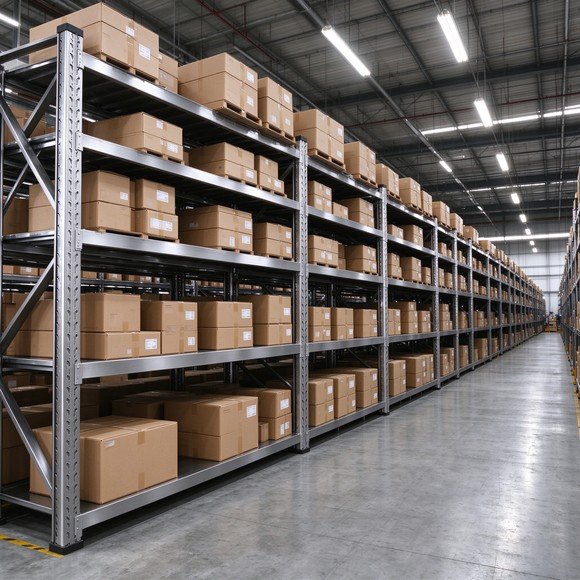
Warehouse Shelving Load per Shelf — How Buyers Work Out a Safe Capacity Before They Order
A warehouse supervisor stacks cartons four high across a shelf. The rating sticker on the frame says 2000 kg, so nothing seems wrong. Three weeks later the middle shelf bows in the centre, and the boxes on it sit at a slight angle.
Nothing was defective. The number on the frame was the rating for the whole bay. The shelf was loaded as if it applied to one level. That mix-up is the most common cause of bent shelves we hear about. A fifteen-minute calculation before ordering avoids it.
Per shelf and per bay are two different numbers
Every shelving rating answers one of two questions. The per-bay figure is what the uprights, braces and feet carry in total. The per-shelf figure is what a single level, its beams and its deck carry on their own.
A bay rated 2000 kg might sit on four shelf levels. Spreading that across four shelves suggests 500 kg per level. But the shelf rating may be 300 kg, and the bay total includes the weight of the shelves themselves. The safe working number for loading is the lower of the two. It is the shelf rating that fails first.
This is why the question to ask a supplier is not “how strong is the rack”. It is “what does each shelf level carry, and at what spread”. The answer should arrive as two figures with the beam pitch written next to them.
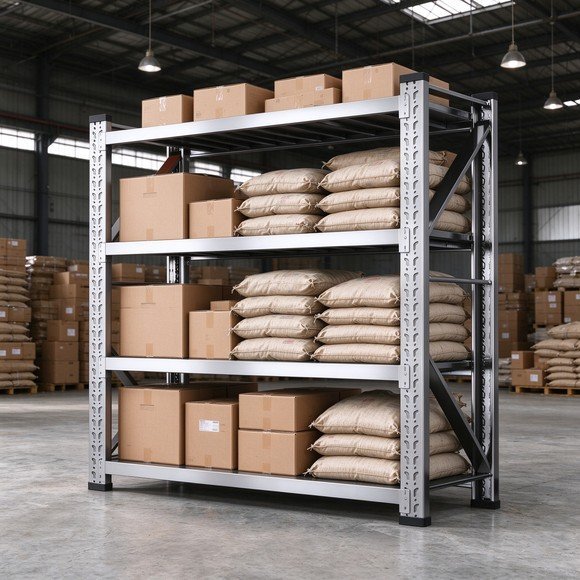
The three inputs that set a shelf rating
First, the beam. Its capacity depends on its profile and the span between uprights. The same beam carries less as the span grows, because the load acts on a longer unsupported length.
Second, the deck. Chipboard, steel panel and wire mesh each spread weight differently. A deck that flexes under load shares weight with nearby beams. The rating sheet may not describe that behaviour.
Third, the pitch. Ratings are quoted at a specific distance between beams. Raise the pitch to fit taller cartons and the rating drops, sometimes by a large margin. A quote without a pitch figure is not a rating at all.
A worked example you can copy
Take a bay 2000 mm wide with four shelf levels, each rated 400 kg at that width. The goods are cartons of 12 kg each, and each carton occupies a 400 × 600 mm footprint.
One shelf level holds roughly eight cartons across the width and two deep, so sixteen per level. That is 192 kg. Against a 400 kg rating, the shelf runs at just under half capacity. That leaves room for the occasional heavier pallet.
Now change one input. The cartons become 25 kg. Sixteen of them reach exactly 400 kg, which is the rating with nothing spare. The right move is either a lower pitch with more levels, or a heavier beam. The bay did not change. One number inside it did.
| Check | What to write down | Why it matters |
|---|---|---|
| Shelf rating at your span | kg per level, at the width you order | Ratings drop as span grows |
| Bay total | kg for the whole upright frame | Sets floor loading, not shelf loading |
| Load per carton or tote | kg, counted at the heaviest item | One heavy SKU breaks an average |
| Units per level | count, at the real footprint | Turns a rating into a stacking rule |
| Utilisation | load ÷ rating, keep at or under 80% | Leaves margin for the odd heavy drop |
Distributed load and point load are not the same test
Ratings assume the weight sits evenly across the deck. A drum on two bearers concentrates the same kilos into a smaller patch. A steel foot plate at one corner does the same. Deck boards dent, wire meshes spread the point load better, and steel panels sit between the two.
This is why the goods list matters as much as the total. If the heaviest item is a drum or a crate on runners, say so when you ask for a rating. The answer may be a different deck, not a bigger number.
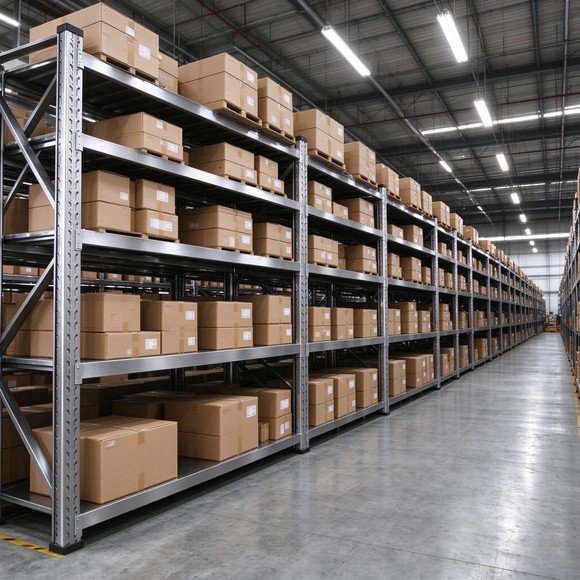
What an inspection looks for on loaded shelving
Most warehouse checks are short. They look for a load notice on each bay and shelves stacked evenly. Nothing should project past the uprights, and beams must seat in all connectors.
Two habits keep a rack ready for that walk-through. Print the per-shelf figure on the load notice, not the bay figure. The crew stacking cartons then sees the number that applies. Record the assumed load per carton in the same place. A rating without an assumption is a guess someone will eventually test.
Where a rating quietly stops being true
A shelf rating is a laboratory statement. Four things take it apart in the field. Damaged beams, even a light knock from a pallet truck, cut capacity well before the damage looks serious. Overhanging loads shift weight past the beam ends. Uneven floors load two feet instead of four. And re-pitching shelves for taller stock invalidates the figure the rating was quoted at.
Any one of these is a maintenance conversation, not a design flaw. A bay that gets checked after every knock keeps its rating. A bay that nobody re-inspects after five years of re-pitching is running on a number that no longer describes it.
Common questions
How much weight can a warehouse shelving shelf hold? It depends on three things: the beam profile, the span between uprights and the deck type. Medium-duty boltless shelving commonly sits between 200 and 500 kg per level at a 1000 to 2000 mm span. The figure to trust is the one quoted at your exact span, in writing, not a catalogue maximum.
What is your MOQ? It depends on the model and the finish. Mixed containers with several shelving sizes together are normal for importers.
How do you quote? Send the bay size, the shelf count, the heaviest item and the destination port. A quote follows within 24 hours, with the load rating per level written in.
Can we get load notices for our racks? Yes. Each bay ships with a notice, and we can print your per-shelf figure on it before the container loads.
Can you do OEM? Yes — silk-screen logo, custom deck colours and custom packing. Artwork approval happens before production.
The short version
Work from the shelf rating, not the bay rating, and confirm it at your real span. Count the heaviest item, not the average one. Keep utilisation near eighty per cent, so one odd pallet does not become a bent beam. Write the per-shelf figure on the load notice so the people stacking cartons see the number that actually applies.
Send the bay size and the heaviest item you store. We will come back with a per-shelf rating at your span, and a quote within 24 hours.
Related guides
- Boltless steel shelving guide — beam pitch, deck type and how load ratings are actually quoted.
- Heavy-duty storage rack buyer guide — the deck types that fail in year two and what to check instead.
- All warehouse shelving guides — pitch, decks, floors and the numbers behind a safe rack.
Janitorial Chemical Storage — Spill Trays, Shelf Loads and What Inspectors Actually Check
A chemical store rarely fails because somebody mixed two products on purpose. It fails because a...
Read articleCassette vs Slide Storage Cabinet — Drawer Sizing, Capacity Math and Splitting the Archive
A wax block and a glass slide are not two versions of the same object. The...
Read articleKnock-Down Steel Filing Cabinet — Flat-Pack Loading and the Container Math Importers Miss
Importers do not buy filing cabinets. They buy space on a ship, and the cabinet is...
Read article