
30 vs 45 Gallon Explosion-Proof Cabinet: How to Size It for Your Lab
30 vs 45 Gallon Explosion-Proof Cabinet: How to Size It for Your Lab
Seven out of ten buyers who ask us about explosion-proof cabinets start with the same question: how big should I buy?
30 gallons or 45 gallons is the most common split in laboratory purchasing. The price difference between the two is small, but the cost of getting it wrong is not. Buy too small and the next chemical delivery has nowhere to go. Buy too large and you eat a chunk of lab floor that you probably do not have to spare.
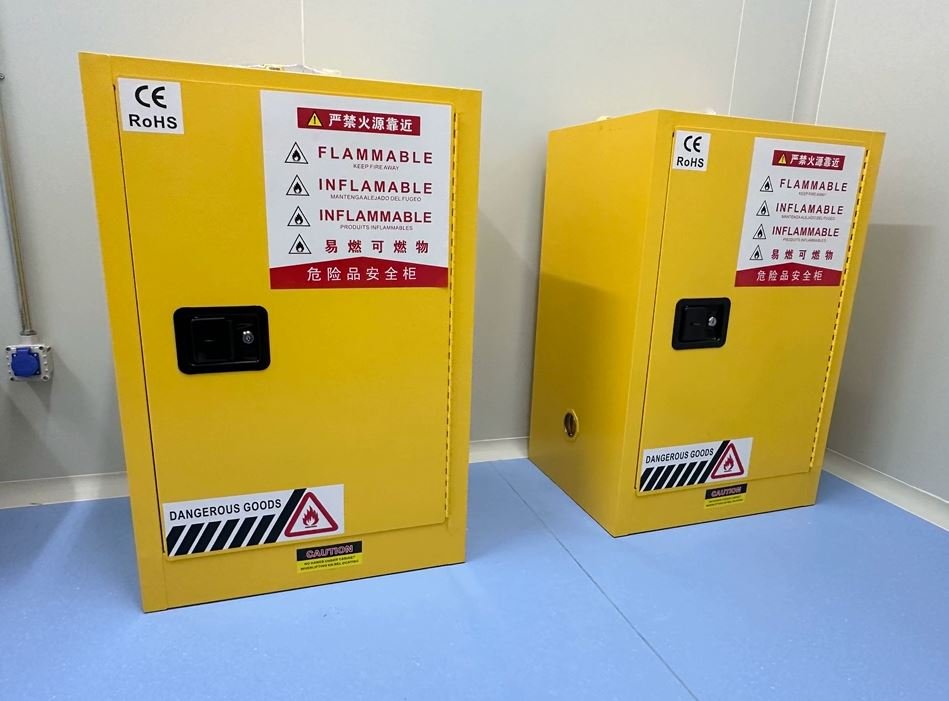
This guide walks through how to size a cabinet to your actual chemical inventory, not to a guess.
What the gallon numbers actually mean
Explosion-proof cabinets are labeled by total internal volume. 30 gallons is about 113 liters. 45 gallons is about 170 liters. But you cannot fill that volume edge to edge with bottles. There are gaps between containers, shelf rails, and the spill tray that takes up the bottom. In practice, the usable storage space is about 70 to 80 percent of the rated capacity.
| Size | Total volume | Approx. usable space | Typical use |
|---|---|---|---|
| 12 gal | 45 L | 32-36 L | Small prep room, single process |
| 30 gal | 113 L | 80-90 L | School labs, clinics, small workshops |
| 45 gal | 170 L | 120-135 L | Research labs, chemical plants, pharma |
| 90 gal | 340 L | 240-270 L | Bulk storage, factory-scale use |
Three steps to size a cabinet
Step 1. List every flammable chemical in your lab. Ethanol, acetone, methanol, thinner, whatever you store. Note how many bottles of each and the volume per bottle.
Step 2. Add up the total liquid volume and convert to gallons. One gallon is about 3.8 liters. If your total comes to 60 liters, that is roughly 16 gallons.
Step 3. Multiply by 1.5. That factor is your headroom for future purchases. Sixteen gallons times 1.5 is 24 gallons. Round up to the next standard size, which is 30 gallons. Done.
If the math lands between two sizes, always round up. A slightly empty cabinet costs less than a full one that cannot hold the next delivery.
Real-world split from our export orders
In the orders we ship from Luoyang, the split between 30 and 45 gallon models falls along clear lines.
Schools, teaching labs, and small clinics order 30 gallon cabinets most often. Their flammable inventory is a handful of ethanol and acetone bottles. A 30 gallon unit on the wall of the prep room covers it.
Pharmaceutical R&D, chemical plants, and mid-sized research labs order 45 gallon models as the default. Solvents arrive by the case, not the bottle. Forty-five gallons holds a case load with room to separate categories.
Large industrial users go to 60 or 90 gallons, or buy multiple 45s and split storage by chemical class. We will cover multi-cabinet layouts in a separate guide.
Two traps to check before you order
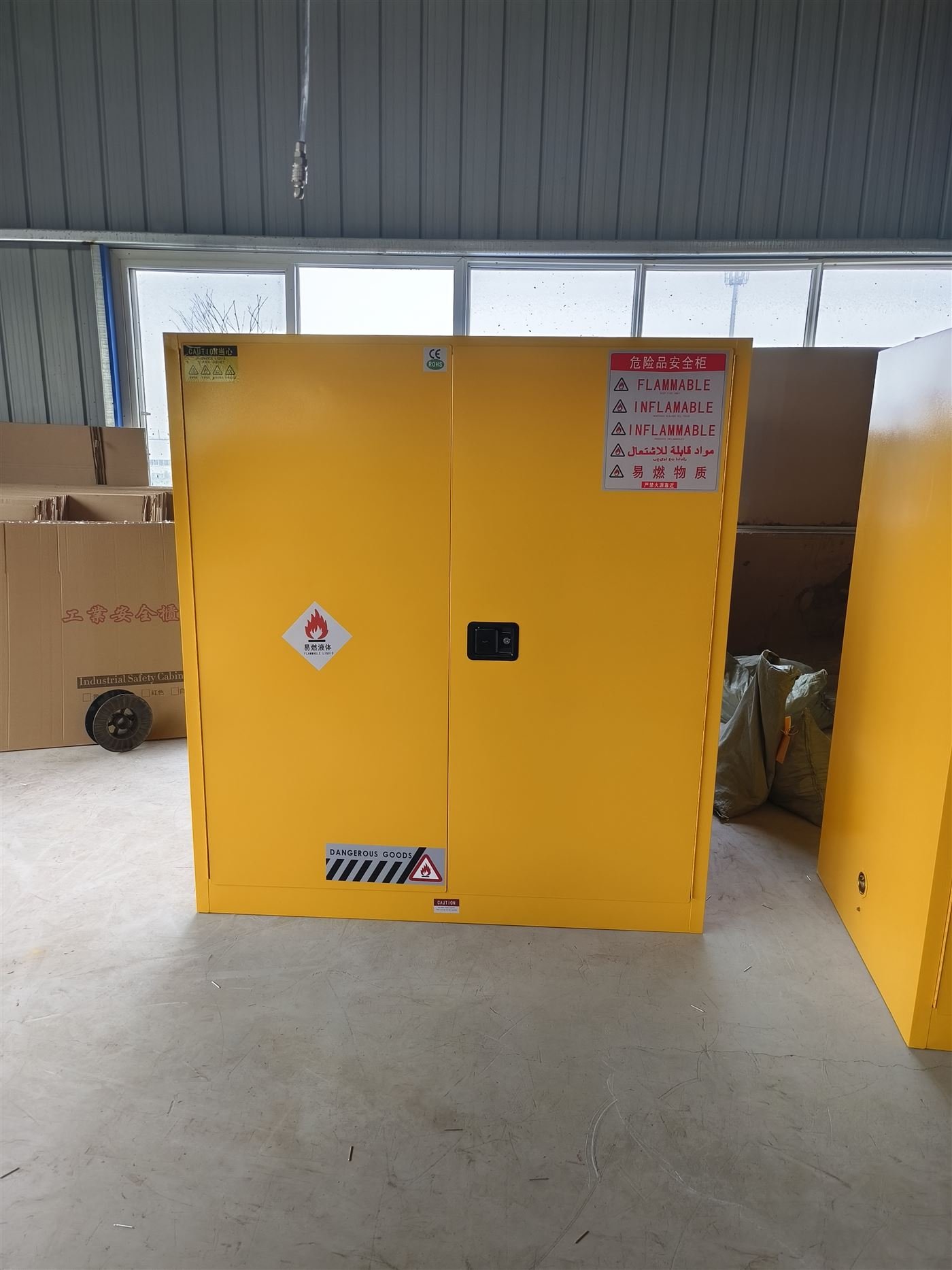
Trap 1: Looking at gallons, not at the actual dimensions. A 30 gallon and a 45 gallon cabinet differ in height, width, and depth. Before ordering, measure the spot where the cabinet will sit, and measure the door the cabinet has to pass through to get into the lab. We have seen cabinets delivered that could not fit through the lab door. Measure first.
Trap 2: Ignoring the weight when full. A 45 gallon cabinet loaded with chemical containers can weigh several hundred kilograms. If your lab is on an upper floor, check the floor load rating. Buildings converted from older use are the most common problem. A cabinet that is fine on the ground floor may need a load spreader plate on the third floor of a renovated building.
Signs you picked the wrong size
If you already own a cabinet and you are wondering whether it is the right size, check these three signs.
Sign 1: the door closes tight against the bottles. If you have to rearrange containers every time you close the door, the cabinet is at or past its working capacity. That is the moment to order the next size up, before a delivery forces the decision.
Sign 2: half the shelves hold things that do not belong. Explosion-proof cabinets are for flammable liquids and chemicals, not for gloves, manuals, or cleaning supplies. If those items drift into the cabinet because space is available, the cabinet is bigger than your actual need. A smaller unit, correctly used, beats a big one that becomes a general storage bin.
Sign 3: flammable bottles live in a second, ordinary cabinet. If part of your chemical stock sits in a regular steel cabinet or under a fume hood because the safety cabinet is full, the cabinet is too small. Fix this one quickly: the whole point of the purchase was to stop doing that.
Custom sizing: the cabinet does not have to be standard
If your chemical inventory falls between 30 and 45 gallons, or if your bottles are unusual in shape (for example, a steady supply of 5-gallon drums), you do not have to pick a stock size and make it work. We build cabinets to order on our own production line in Luoyang. Non-standard heights, extra-deep shelves for drums, and split interiors that separate acids from flammables in one cabinet body are all routine OEM work.
If you are buying for a chain of facilities, a consistent custom size across all locations makes training and inspection simpler. We quote batch production for multi-site buyers with the same dimensions, color, and labeling on every unit.
How we confirm the size with you
When you send an inquiry, we do not push a catalog at you. We ask for the chemical list, the bottle sizes, and the lab layout constraints. From that we recommend a gallon size, a shelf configuration, and a door type. If you already know the size, we confirm it fits your use and quote factory-direct. Before production starts, we send a spec sheet for your sign-off. Before the container leaves, we send photos of the finished cabinets.
Common questions
Can I put two 30-gallon cabinets side by side instead of one 45? Yes, and some labs prefer it. Two smaller cabinets let you separate flammables from acids while keeping the storage in the same area. The trade-off is floor space: two 30s take more width than one 45.
Does a self-closing door change the capacity? No. The self-closing mechanism is in the door hinge and does not reduce internal storage. A 30 gallon cabinet holds the same whether the door is manual or self-closing.
How much clearance do I need around the cabinet? Leave at least 5 cm on each side for ventilation and 30 cm of clear space in front for the door to open fully. Do not push the cabinet flush against a wall on both sides.
Can you make a cabinet to fit a specific space? Yes. Tell us the maximum width, depth, and height you can accommodate, and we will build to those dimensions. Custom sizes are how a lot of our OEM orders work.
Is a bigger cabinet always safer? Not necessarily. A cabinet that is too large for your stock often gets filled with non-chemical items, which defeats the purpose and complicates inspections. Match the cabinet to your chemical volume, keep it dedicated, and label the shelves.
The short version
Count your chemicals, convert to gallons, multiply by 1.5, and round up to the next standard size. If the answer is between 30 and 45, pick 45. If you are not sure, send us the chemical list and we will tell you in one reply.
How to Choose a Laboratory Explosion-Proof Cabinet: Material, Capacity, Shelves, and Doors
Steel construction, gallon sizes, shelf load, and self-closing doors: four checks before you buy.
Safe Chemical Storage: PP Container Cabinet Parameters for Laboratories
Acid and alkali resistance, tray design, and material thickness to check before buying PP cabinets.
How to Choose High-Density Employee Lockers: Steel 12-Door Knockdown Guide
Door count, ventilation, and frame gauge: what matters when you outfit a hundred-person locker site.